
In 2026, the top contract management software solutions include platforms like DocuSign CLM, Ironclad, Agiloft, and Icertis, each known for strengths in automation, customization, or enterprise capabilities. However, organizations today are increasingly prioritizing solutions that combine usability, scalability, and cross-functional workflows in a single platform. Aavenir stands out as a top contract management software for fast-growing companies, modern teams, and large enterprises, offering enterprise-grade capabilities that support complex workflows across Legal, Procurement, Finance, IT, and Sales.
Managing contracts can be a challenging task. With complex approval processes, endless paperwork, and strict deadlines, it’s easy to see why many businesses struggle to keep track. Whether you’re dealing with dozens or hundreds of contracts, manually managing them can lead to missed deadlines, compliance issues, and increased risk.
The real challenge? Finding a contract management software that simplifies all of this—something that helps you:
- Keep contracts organized and accessible for everyone involved.
- Automate approval workflows to speed up processes.
- Ensure compliance and track key obligations with ease.
- Integrate seamlessly with your existing business systems.
- Provide real-time insights into contract performance and risk.
If you are looking for software options that tick these boxes, you are at the right place. We have curated a list of the 10 best contract management software solutions that meet these specific needs—highlighting their USPs, strengths, key features, pros, and cons of each platform so you can make an informed decision.
We’ll evaluate the top options head-to-head to help you pick the right platform for your legal operations. Let’s get started by understanding how we curated this list.
How We Shortlisted the Top Contract Management Solutions
To identify the 10 best contract management solutions, we started with an initial list of 50 platforms gathered through competitor analysis and user insights from trusted review sites like G2, Capterra, and TrustRadius. We then narrowed down the list based on key factors such as functionality, scalability, ease of use, integration ecosystem, and customer feedback patterns.
- User Reviews: We analyzed user feedback and ratings from G2 and Capterra to assess the popularity, satisfaction, and demand for each solution.
- Market Popularity: To understand how real users perceive these solutions, we examined discussions on Reddit, Quora, and industry forums.
- Ease of Use: We analyzed user-reported ease-of-use scores from G2 and customer testimonials to prioritize platforms with the best UX and minimal learning curve.
- Features and Functionalities: We ensured that each shortlisted platform has features for creation, review, redlining, negotiation, signature, storage, analysis, and monitoring.
- AI and Automation Capabilities: We prioritized platforms that leverage AI and automation for drafting, review, risk management, and obligation tracking.
- Integration Options: We shortlisted platforms with diverse integration options to ensure connectivity across your business workflows.
This exercise helped us curate our list of the top 10 contract management solutions that offer the best features, automation, user experience, and industry relevance.
Gain 5X Better Visibility Over Your Contracts
Centralize, automate, and optimize your contract workflows with Aavenir. Stay ahead of contract risks and ensure compliance.
What Is the Best Contract Management Software in 2026?
The best contract management software in 2026 depends on organizational needs, industry requirements, and workflow complexity.
Leading platforms include:
- DocuSign CLM – Best overall adoption
- Ironclad – Best for legal teams
- Agiloft – Best for customization
- Icertis – Best for enterprise organizations
- Aavenir – Best for scalable, cross-functional contract management across Legal, Procurement, Finance, IT, and Sales
How to Choose the Right Contract Management Software by Company Size
Selecting the right contract management software depends heavily on company size, operational complexity, and growth stage. Startups, mid-size organizations, and large enterprises have different requirements for scalability, workflow automation, and compliance management.
Startup Companies
Startups typically need a contract management solution that is easy to implement, affordable, and simple to use.
Key priorities include:
- Quick deployment
- Ease of use
- Basic workflow automation
- Cost efficiency
- Integration with existing tools
For startups and fast-growing companies, selecting a scalable platform ensures the system can support future growth without requiring replacement.
Mid-Size Companies
Mid-size organizations require more structured workflows, visibility, and reporting capabilities as contract volume increases.
Key priorities include:
- Workflow automation
- Integration with CRM or procurement systems
- Reporting and analytics
- Role-based access controls
- Compliance management
At this stage, organizations often transition to enterprise-grade contract management software to support expanding operations.
Enterprise Organizations
Large enterprises managing complex workflows across departments and regions require advanced automation, governance, and scalability.
Key priorities include:
- Enterprise-grade security and compliance
- Advanced workflow automation
- Integration with ERP, CRM, and finance systems
- Custom process configuration
- Real-time reporting and analytics
Enterprise organizations benefit from highly customizable platforms that support complex approval structures and regulatory requirements.
Detailed Overview of the Top Contract Management Software
Wondering what are the core features, pros, cons, and standout points of each software on our list? This section covers all this information to help you analyze and compare these solutions. Let’s start with a walkthrough of our platform, Aavenir.
1. Aavenir Contractflow
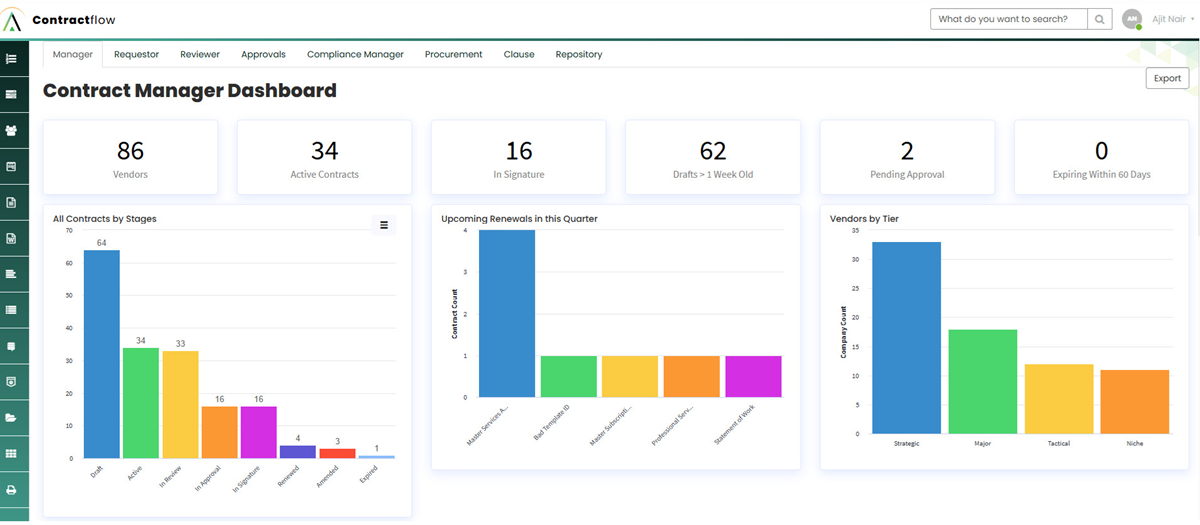
Aavenir provides an enterprise-grade contract lifecycle management (CLM) platform designed for fast-growing companies, mid-market organizations, and large enterprises managing complex workflows. The platform combines contract lifecycle management, compliance management, and workflow automation in one scalable system with strong usability and speed.
With built-in e-signatures, AI-assisted contract review, advanced analytics, and centralized data and reporting, Aavenir enables modern teams to manage contracts efficiently while supporting complex, custom processes across Legal, Procurement, Finance, IT, and Sales. Its flexible architecture allows organizations to tailor the software to their unique business needs while maintaining governance, visibility, and operational control.
With Aavenir’s AI-based legal assistant, Avy, you can get more work done with less effort. Some of the key capabilities of Avy include:
- Ask Avy to find critical contract data within seconds
- Generate compliant clauses that align with your legal standards
- Simplify complex legalese into easy-to-understand information
- Summarize counterparty contracts for quick first review
- Spot-compare third-party papers with your approved language
- Integrate Aavenir with your business apps for organization-wide connectivity
Here are some key metrics showcasing the impact of using Aavenir:

Key Features of Aavenir Contractflow
Aavenir offers a complete suite of features for end-to-end contract management. Some of the key features offered by the platform include:
- Contract Authoring: Speeds up contract creation with AI-generated clauses, smart intake forms, pre-approved templates, and clause libraries.
- Automated Workflows: Helps create customized workflows for creation, review, negotiation, and signature—enabling quick, bottleneck-free contract execution.
- Negotiations: Streamlines review and negotiation cycles with real-time redlining, version control, and AI-powered risk analysis.
- KPI Management: Auto-tracks pre-execution performance metrics like TAT, bottlenecks, review time, and draft time. Helps conduct compliance checks with a central dashboard.
- Centralized Repository: Maintains a secure single source of truth for all executed contracts with AI-based metadata extraction, smart search, and controlled share access.
Pros and Cons of Using Aavenir Contractflow
Aavenir Differentiators
1. AI-First & Agentic Contract Intelligence
Aavenir goes beyond static AI features by using Agentic AI, AI agents that actively work across the contract lifecycle rather than reacting to isolated user actions. These AI agents enable:
- Autonomous contract data extraction
- Cross-contract obligation discovery
- Continuous risk monitoring
- Intelligent contract insights without manual querying
This allows enterprises to move from passive contract storage to active contract intelligence.
2. Native Obligation Management (Not an Add-On)
Unlike most CLM platforms, where obligation tracking is either basic or an extension module, Aavenir treats Obligation Management as a core capability. It enables:
- Automatic extraction of contractual obligations using AI
- Conversion of obligations into trackable tasks
- SLA and compliance monitoring across departments
- Proactive alerts for missed milestones and regulatory risks
This positions Aavenir not just as a CLM tool, but as a post-signature compliance and performance engine.
3. Built on the ServiceNow Platform (Enterprise-Grade, No-Code)
Aavenir is natively built on the ServiceNow platform, giving enterprises:
- True no-code configuration
- Enterprise-grade security and scalability
- Native integration with ITSM, Procurement, GRC, Finance, and HR workflows
- Role-based access, audit trails, and enterprise data governance
For organizations already using ServiceNow, Aavenir becomes a seamless extension of their digital operations ecosystem.
4. Unmatched Workflow & Configuration Flexibility
Because Aavenir runs on ServiceNow’s workflow engine, customers can:
- Design contract workflows without custom code
- Configure approval rules by contract type, region, value, or business unit
- Orchestrate cross-functional contract execution across Legal, Procurement, Finance, and Operations
This flexibility allows enterprises to mirror real-world business complexity without platform limitations.
5. Complimentary Sourcing & RFP Automation with RFPflow
Aavenir uniquely extends beyond CLM with RFPflow, a purpose-built sourcing and RFP automation solution. This allows organizations to:
- Initiate sourcing directly from contract needs
- Automate vendor evaluation and bid comparisons
- Seamlessly convert awarded bids into executable contracts
This makes Aavenir one of the few platforms that connect sourcing, contracting, and obligation management end-to-end.
Best Fit For
Fast-growing companies, mid-market organizations, and large enterprises that need an enterprise-grade contract management platform capable of handling complex workflows across multiple departments.
- Enterprises using or standardizing on ServiceNow
- Heavily regulated industries (Healthcare, BFSI, Energy, Manufacturing)
- Organizations with high contract volumes and post-signature compliance needs
- Procurement-led digital transformation programs
- Businesses that require AI-driven obligation intelligence and workflow automation
What Aavenir’s Users Have to Say
Lastly, let’s hear directly from Aavenir’s users about their experience in using the platform. Here are a few user testimonials from G2:
4/5 Stars
Aavenir is helpful in tracking contract lifecycle and provides the opportunity to proactively initiate contract renewal. It has a fair few helpful feature like Docusign integration and integration with ServiceNow.
Verified User in Mining & Metals
Enterprise (> 1000 emp.)
4/5 Stars
I loved the clean, simplistic look of the dashboard and mostly intuitive features of the interface. The standard offering of the products works seamlessly if it is complemented by the relevant apps that enable the full functionality of the platform.
Commercial, Products and Functions Lead, Legal
Mid-Market (51-1000 emp.)
Ready to Automate Your Contract Lifecycle?
Switch to Aavenir for streamlined, AI-powered contract creation, approval, analysis, and tracking.
2. Juro
Source: G2
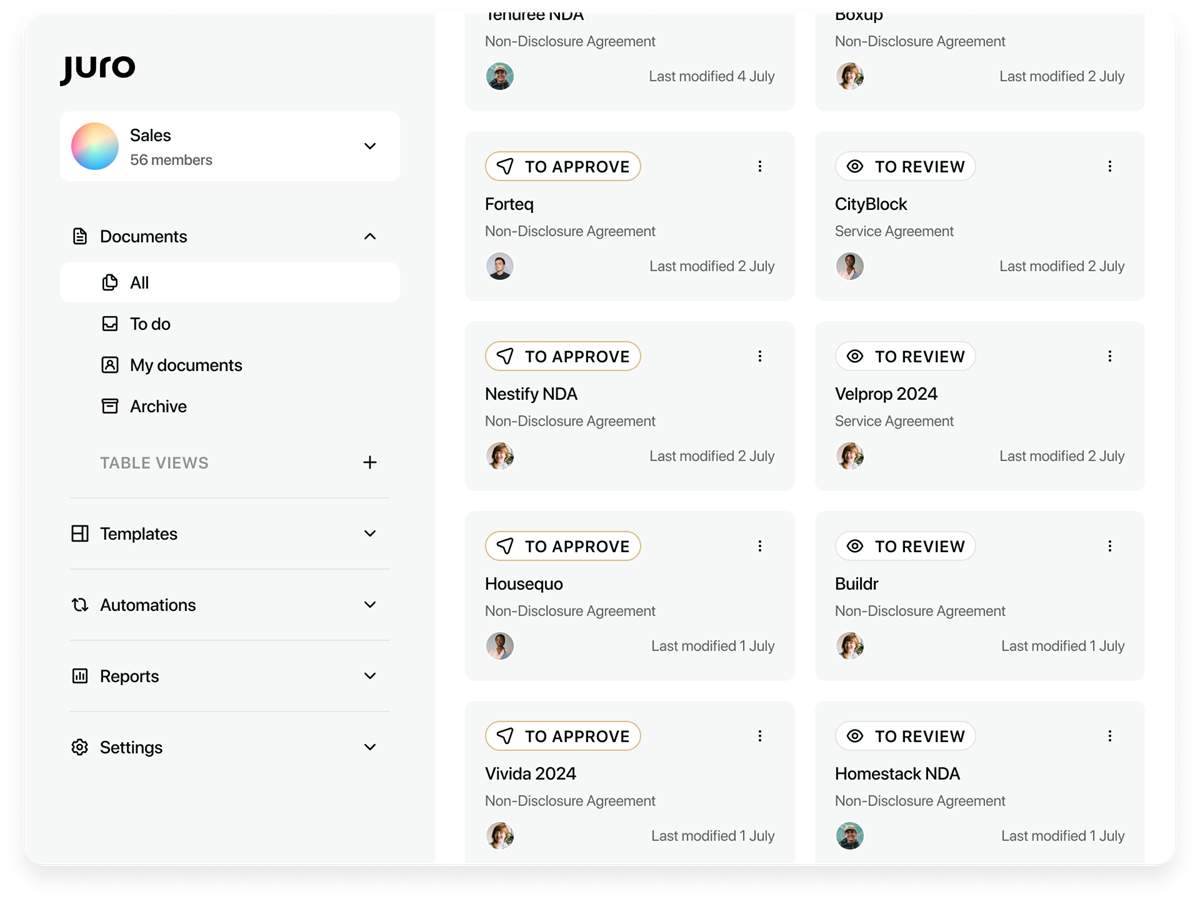
Ranking second on our list of the best contract management software is Juro – an AI-powered, flexible, and integrable contract lifecycle management tool. Juro’s platform is designed to give legal teams full control over contracts while promoting collaboration with sales, procurement, HR, and operations teams.
Juro’s AI legal assistant automates routine tasks such as data extraction, drafting, and review, greatly enhancing contract management efficiency. Additionally, Juro’s integration with core business apps like CRMs, HR platforms, and communication tools—along with custom integration options—ensures smooth collaboration across the organization.
Juro’s pricing is based on your team’s size and specific contract management needs. The pricing plans are ideal for enterprises and large-scale teams looking for an advanced CLM software. However, for teams exploring Juro alternatives—whether for different features, pricing models, or specific integrations—there are several other contract management solutions on the market that may better suit unique organizational requirements.
Core Features of Juro
Here are the core features and functionalities of Juro:
- Creation: Helps initiate contracts with self-serve templates, drag-and-drop fields, and AI-native workflows.
- Sign: Provides native, legally compliant eSignature options for convenient signing. Helps add signatories with drag-and-drop functionality.
- Store: Creates a unified space for storing contracts. Helps auto-fetch contracts with structured search and improves protection with access control.
- Track: Auto-tracks important obligations from contracts. Creates reminders for critical obligations—ensuring compliance with contractual commitments.
Pros and Cons of Using Juro
Here are the pros and cons of using Juro, as per user reviews and experiences on G2:
| Pros | Cons |
| Highly intuitive with swift onboarding and easy implementation. | The workflow builder can be challenging for first-time users. |
| Customizable to meet the needs of different teams and contracting processes. | Limited formatting options in the native editor for contract creation. |
| Excellent onboarding support and prompt responses to customer queries. | Users have reported issues managing complex agreements using the platform. |
| Continuous updates and feature upgrades enhance usability. |
3. CobbleStone Contract Insight
Source: G2
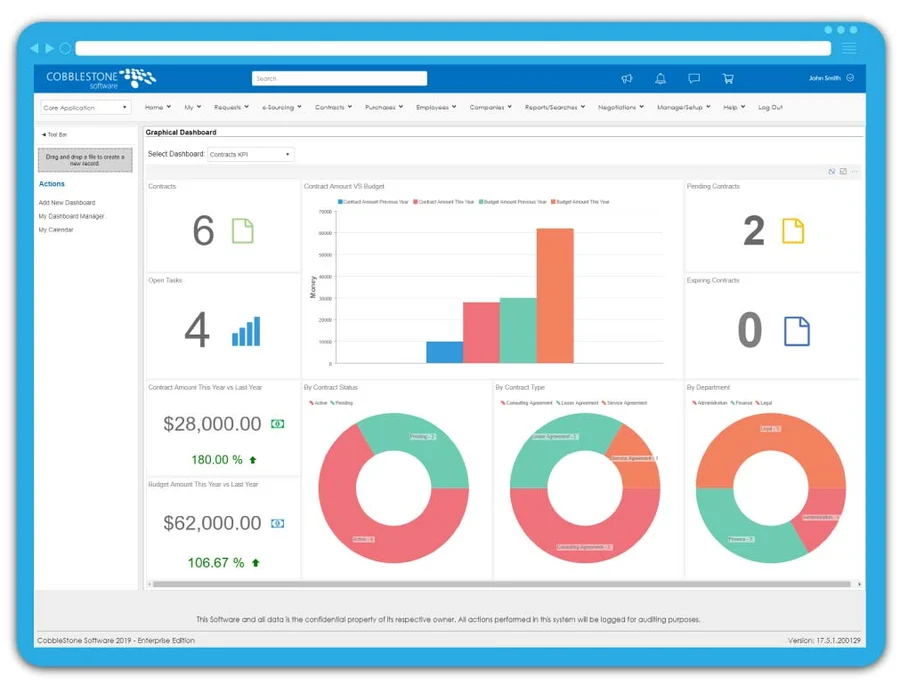
CobbleStone Contract Insight is an enterprise-level contract management software designed to manage contracts at scale. Built specifically for procurement teams, it offers customizability and scalability in contract processes, making it ideal for organizations with complex, large-scale contract management needs.
CobbleStone’s VISDOM—an AI model for contract automation—helps analyze contracts, identify opportunities, mitigate risks, and streamline the overall contract management process, improving both efficiency and effectiveness.
Core Features of CobbleStone Contract Insight
Here are the core features of CobbleStone Contract Insight:
- Document Management: Organizes, stores, and retrieves contracts in a centralized, secure contract repository. Enables structured search, version control, and metadata tagging for quick access.
- Request Tracking: Helps you stay on top of contract requests with real-time status and insights on each request. Enables smooth request management across teams.
- eSignatures: Helps collect legally binding eSignatures for faster signing and quicker execution.
- Custom Reporting: Generates data-driven contract insights with custom dashboards, KPI tracking, and compliance reports.
Pros and Cons of Using CobbleStone Contract Insight
Here are the pros and cons of using CobbleStone Contract Insight, as captured from user reviews on G2 and Capterra:
| Pros | Cons |
| Highly responsive sales reps with prompt support. | CobbleStone’s extensive feature set may be too complex for small-scale organizations. |
| Extensive resource library for self-service troubleshooting. | Complex integrations may require support to configure correctly. |
| Easy-to-navigate, intuitive UI for smoother user experience. | Bulk-importing contracts from spreadsheets with errors may cause import issues. |
| Wide range of integrations for organization-wide connectivity. |
4. Conga
Source: G2
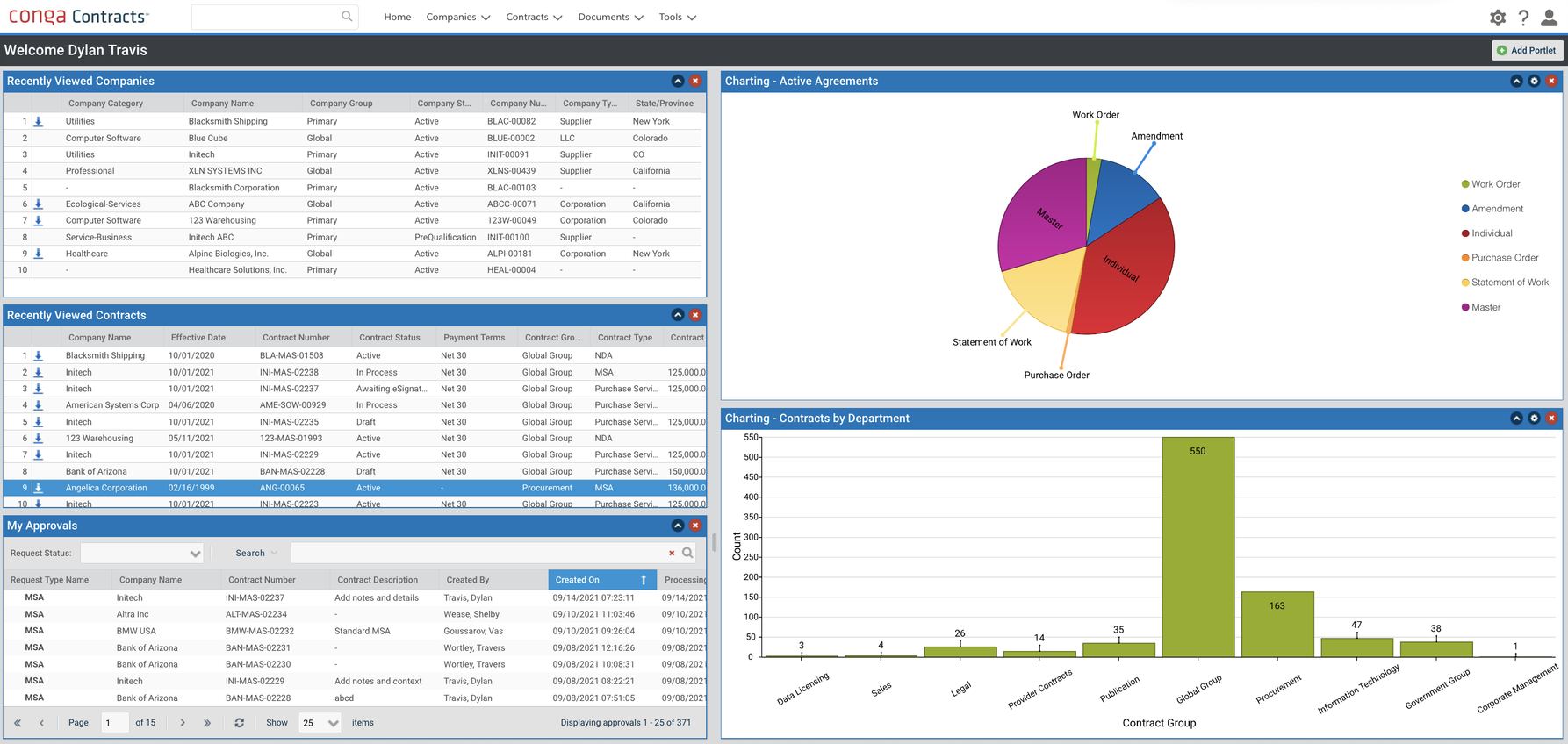
Conga is a long-established leader in contract lifecycle and revenue operations management, offering a broad suite of digital document, CPQ, and CLM capabilities. Known for its strength in complex commercial negotiations and sales-driven contracting, Conga supports businesses looking for robust configurability and tight integration across their revenue processes.
Large enterprises across industries leverage Conga to automate contract creation, gain visibility into commercial terms, and standardize processes that span Legal, Sales, and Finance. Its extensive ecosystem and mature product capabilities make it a strong option for organizations with sophisticated commercial workflows.
Core Features
- Salesforce-Native Experience: Strong alignment with Salesforce CRM, making it ideal for sales-led contracting workflows and revenue operations.
- Document Generation & Template Management: Advanced capabilities for generating, assembling, and managing contract templates.
- AI-Assisted Contract Insights: AI-driven search and analytics that help surface key clauses, deviations, risks, and contract management KPIs.
- End-to-End Revenue & CLM Workflow: Deep integration across CPQ, Order Management, and CLM for unified commercial lifecycle automation.
Pros and Cons of Conga
| Pros | Cons |
| Excellent for sales-driven contracting and complex commercial workflows | Heavily optimized for Salesforce environments; less flexible outside CRM-centric ecosystems |
| Strong document generation and template automation | Implementation may require specialized consulting and longer deployment timelines |
| Mature, enterprise-ready CLM capabilities | Can be expensive for mid-market organizations |
| Robust revenue lifecycle integrations (CPQ, billing, order management) | Customizations may increase long-term maintenance effort |
5. Malbek

Source: G2
Malbek is a modern, AI-enabled CLM platform that focuses on usability, configurability, and rapid deployment. Built with a business-user–friendly interface and flexible workflow engine, Malbek is designed to streamline contracting for fast-growing companies that prioritize simplicity and collaboration without sacrificing enterprise capabilities.
Its integrations, intuitive UX, and robust post-signature analytics make it a popular choice among teams looking to accelerate contracting while maintaining strong compliance and negotiation controls.
Core Features
- No-Code Workflow Configuration: Business teams can create and adjust workflows without IT support.
- AI-Powered Search & Insights: Embedded AI features help identify risks, extract metadata, and improve contract visibility.
- Collaboration & Negotiation Tools: In-browser redlining, versioning, and integrated negotiations streamline collaboration with internal and external stakeholders.
- Contract Analytics Dashboard: Real-time insights into cycle times, contract renewals, bottlenecks, obligations, and risk areas.
Pros and Cons of using Malbek
| Pros | Cons |
| Very easy-to-use interface suitable for non-technical users | Limited native ecosystem compared to older enterprise CLM platforms |
| Quick to deploy with strong no-code flexibility | May require third-party tools for complex enterprise integrations |
| Strong AI capabilities for search, extraction, and metadata management | Scalability may be a concern for extremely large organizations with highly complex workflows |
| Good collaboration and negotiation tools | Advanced analytics require additional configuration or integrations |
6. Ironclad
Source: G2
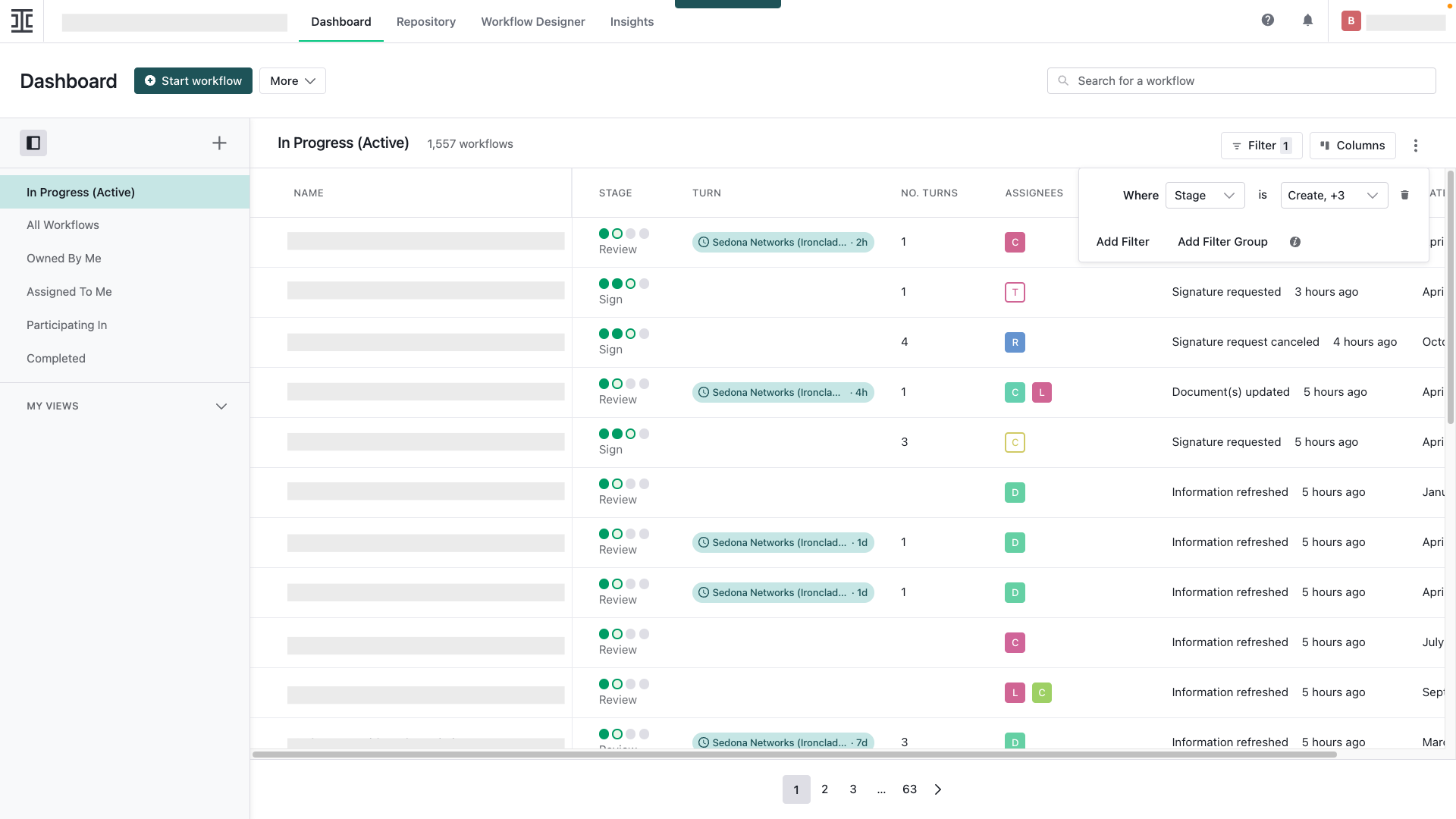
Used by top brands like Asana, Dropbox, and L’Oréal, Ironclad is designed to manage high contract volumes, streamline enterprise operations, and maintain efficiency at scale. This end-to-end contract lifecycle management (CLM) software comes equipped with smart AI technology that automates key tasks like contract generation, review, redlining, and negotiation.
With Ironclad, you can negotiate better deals, ensure compliance, and mitigate business risks—all on a central, easy-to-use platform. If you’re looking to focus on core legal tasks instead of handling mundane paperwork, Ironclad is the ideal solution for your team. Additionally, you can explore Ironclad’s alternatives that offer more than just contract automation for better legal efficiency.
Core Features of Ironclad
- Automated Redlining: Accelerates contract negotiations with AI redlining, version tracking, and smart clause suggestions.
- Workflow Designer: Builds custom contract workflows with an intuitive drag-and-drop interface. Automates approvals, stakeholder assignments, and contract routing for seamless execution.
- Contract Editor: Generates contracts directly within the platform with smart templates, in-line commenting, and collaborative drafting.
- Reporting and Analytics: Tracks contract performance, risks, and cycle times with real-time dashboards. Provides actionable insights for improved compliance, efficiency, and decision-making.
Pros and Cons of Using Ironclad
Based on our an analysis of Ironclad’s user reviews, here are the pros and cons of using this platform:
| Pros | Cons |
| Collaboration features make it easy to manage centralized, seamless negotiations. | Requires training to get familiar with the platform’s full range of features. |
| Flexible workflow designer accommodates the needs of different teams. | Primarily suited for enterprises, making it less ideal for startups or small businesses. |
| Great implementation support from customer service and Ironclad Academy. | UI can feel clunky due to the platform’s wide array of features. |
| Precise alert and tagging features help track contractual obligations effectively. |
Gain Full Control of Your Contracts
With Aavenir, you can track, manage, and optimize contracts effortlessly. From AI-driven insights to easy integrations, make your contract lifecycle more efficient.
7. Agiloft
Source: G2
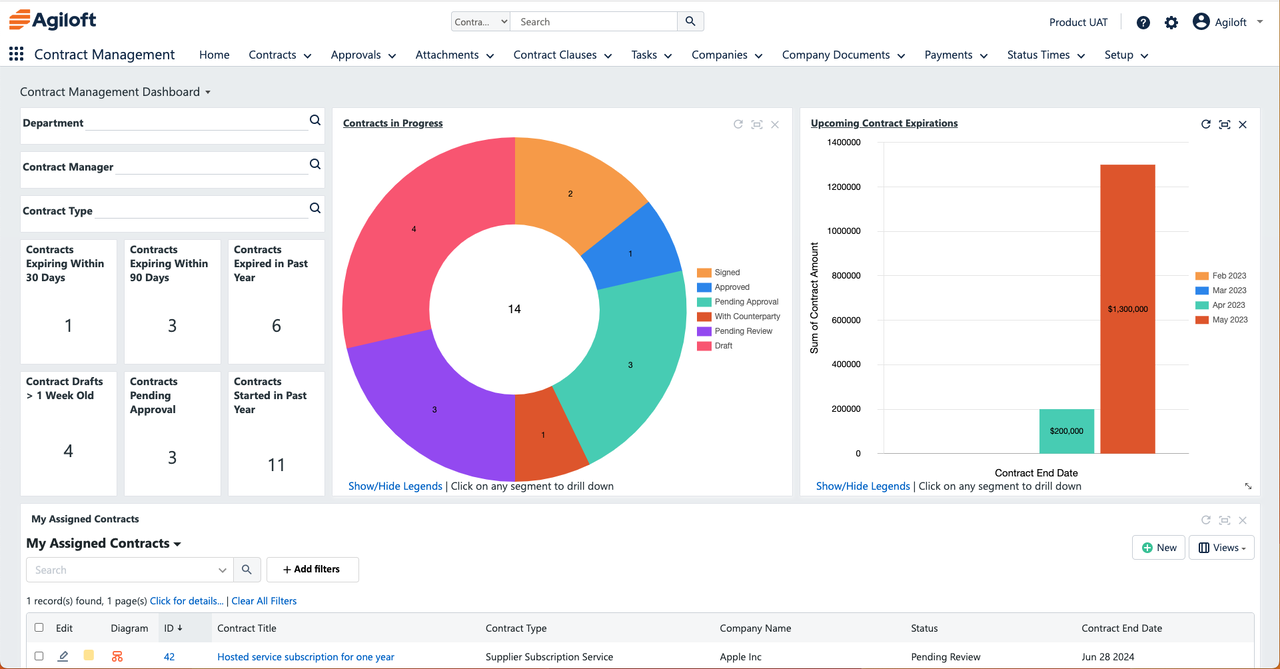
Ranked seventh on our list is Agiloft, an end-to-end contract lifecycle management software known for its customizability and adaptability. It’s a popular choice for businesses looking to automate their entire CLM process with tailored workflows and features.
With a near 100% implementation satisfaction rate, Agiloft is praised for its quick implementation and ease of adoption. If you need customized features and workflows that fit your unique business needs, Agiloft is an excellent choice. If you are looking for advanced CLM automation and integrations, you can check this list of Agiloft alternatives that offer such capabilities.
The pricing plans offered by Agiloft are flexible and suited for SMBs and enterprises, making this tool one of the best choices for budget-friendly CLM automation.
Core Features of Agiloft
- Custom Workflows: Automates contract approvals, reviews, and renewals with fully customizable, no-code workflows. Ensures compliance and eliminates bottlenecks with rule-based automation.
- Drag-and-Drop Integrations: Connects with ERPs, CRMs, and other business tools using a no-code drag-and-drop interface, enabling seamless data flow across systems.
- Contract Editor: Helps edit contracts in real-time with built-in redlining, clause libraries, and collaborative drafting. Maintains all changes and approvals in a single, trackable workspace.
- Insights Dashboard: Provides real-time visibility into contract status, risks, and key metrics with AI-powered analytics. Helps make data-driven decisions.
Pros and Cons of Using Agiloft
Here are the pros and cons of using Agiloft, as per user reviews from G2 and Capterra:
| Pros | Cons |
| The admin panel for adding clauses and editing templates is highly intuitive. | Contract search functionality may occasionally fail to retrieve contracts successfully. |
| Customizable features allow for workflow adjustments in industry-specific use cases. | Some users report limitations with contract amendment features. |
| The implementation team offers tailored solutions for unique requirements. | Some workflows and customizations may require coding and technical fluency. |
| Offers integrations with billing systems to automate billing after contract execution. |
8. Workday
Source: G2
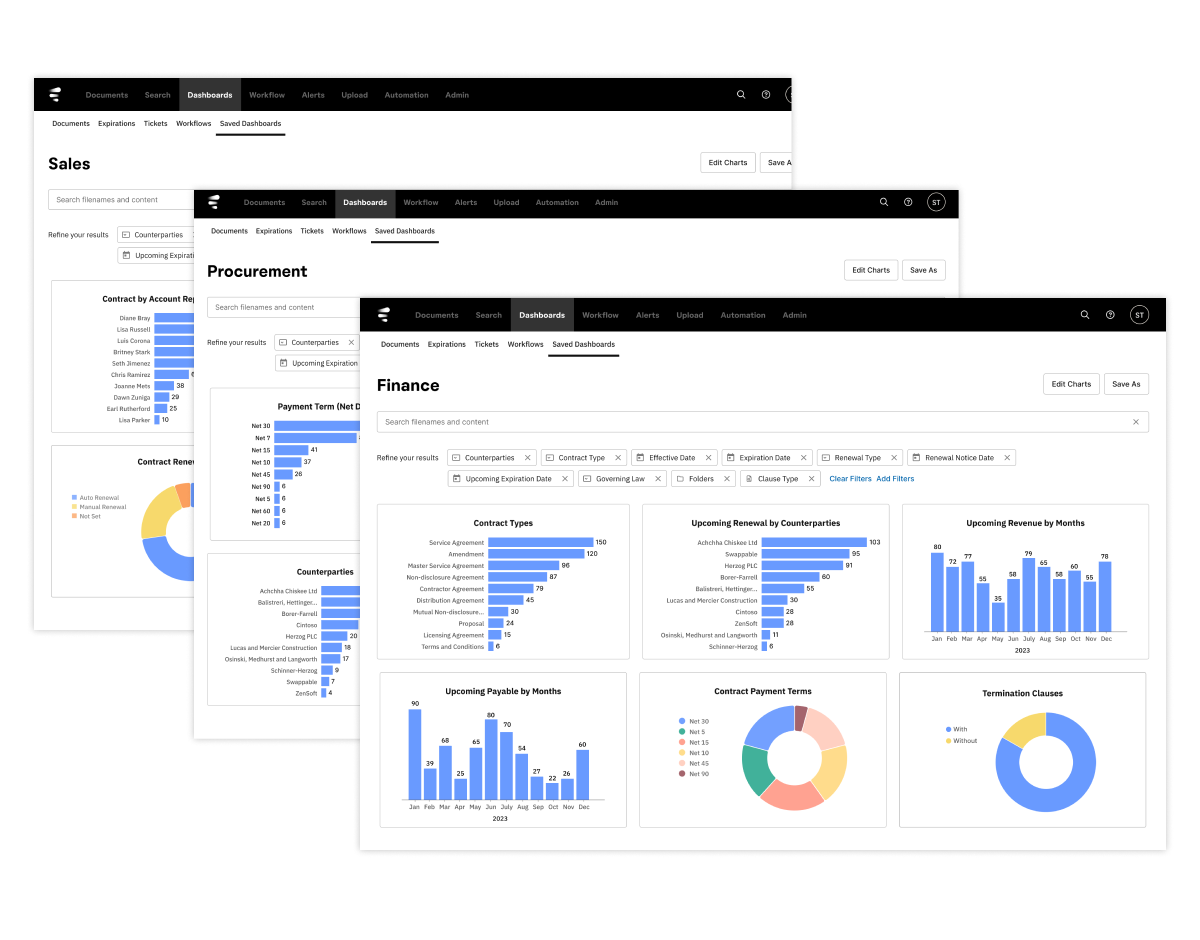
Workday provides contract management capabilities as part of its broader Finance, Procurement, and Supplier Management ecosystem. Designed for enterprises standardizing on Workday for Spend and Financial Management, its CLM functions support supplier contracting, compliance tracking, and integration with upstream procurement processes.
Workday’s native integration with supplier onboarding, sourcing, and financial systems makes it valuable for organizations that prioritize ERP-driven workflows where contracts directly influence finance, procurement, and vendor relationships.
Core Features
- Native to Workday Platform: Seamless integration with Workday Procurement, Financials, and Supplier Management.
- Supplier Contract Repository: Centralized storage with versioning, metadata management, and audit controls.
- Workflow & Approval Automation: Configurable routing for contract approvals tied to organizational roles and spend policies.
- Spend & Compliance Visibility: Direct connection between contract terms, supplier performance, and financial commitments.
Pros and Cons of using Workday
| Pros | Cons |
| Ideal for organizations already using Workday Financials and Procurement | Not a standalone enterprise-grade CLM compared to dedicated CLM platforms |
| Strong integration with supplier lifecycle workflows | Limited AI capabilities relative to modern AI-first CLM vendors |
| Unified data model across procurement and finance | Customization options may be restrictive |
| Reliable for vendor contract compliance and financial governance | Limited negotiation/redlining features, requiring external tools |
9. Icertis
Source: G2
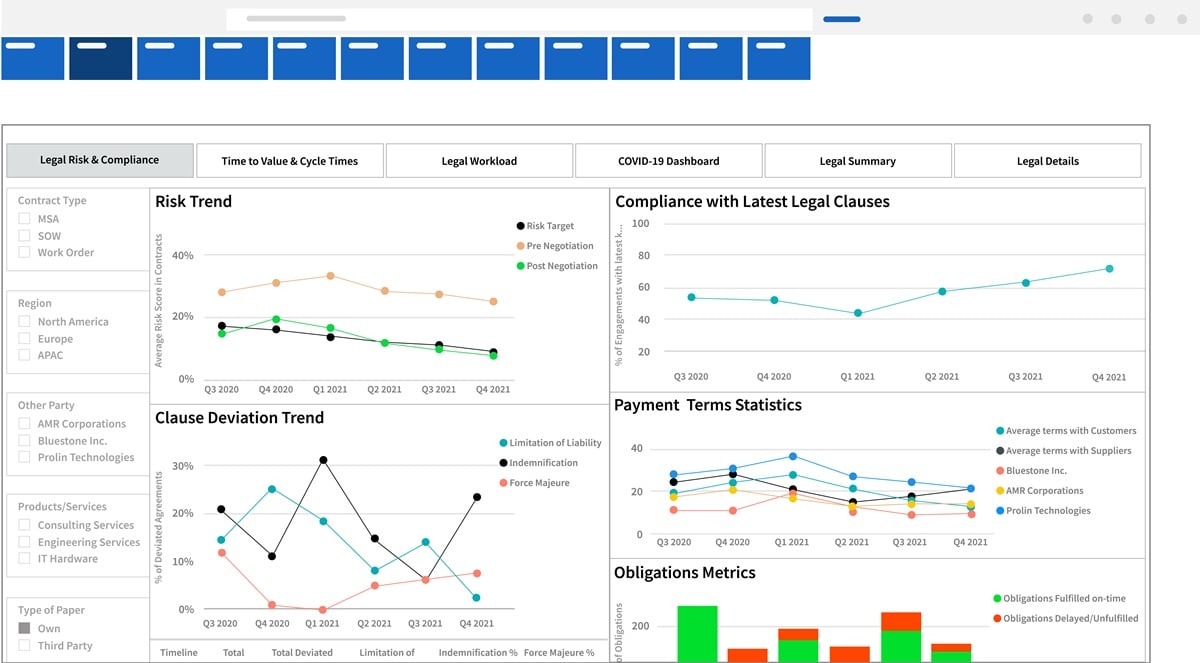
Icertis is an enterprise-grade contract management platform that powers contract intelligence and automation across legal workflows. As per Icertis’ user reviews, the platform’s standout feature is its ability to connect contract data to improve visibility, ensure compliance, and drive revenue growth.
With Icertis, teams in legal, procurement, finance, and sales can speed up contract workflows by up to 83%. Used by Fortune 100 companies, this platform is ideal for managing large contract volumes through AI and automation. Additionally, Icertis competitors offer similar, enterprise-level CLM features. You can explore these alterntives for better pricing and flexibility.
Core Features of Icertis
- Templates: Helps create standardized contracts with pre-approved templates. Ensure consistency, compliance, and faster contract generation for various use cases.
- Negotiation Playbooks: Streamlines contract negotiations with playbooks that guide users through predefined processes. Ensures that all stakeholders follow the correct procedures and maintain consistency during negotiations.
- Intent Realization: Ensures that all contract terms and conditions align with your business objectives. Helps track and validate contract intent, ensuring commitments are met and reducing the risk of misunderstandings.
- Reporting Engines: Generates custom reports to track contract performance, compliance, and risks. Helps gain valuable insights into contract lifecycle metrics and make data-driven decisions.
Pros and Cons of Using Icertis
Here are the pros and cons of using Icertis based on user reviews and feedback from Capterra and G2:
| Pros | Cons |
| Can manage both buyer-side and seller-side contracts. | Implementation can be lengthy, requiring significant time and resources. |
| Reliable AI delivers precise results, eliminating the need for double-checking. | Complex integrations with external apps may delay adoption. |
| Excellent for procurement and supply chain use cases. | Template builder still requires manual drafting and review. |
| Precise deliverable and obligation tracking enhances compliance. |
10. Sirion CLM
Source: Sirion
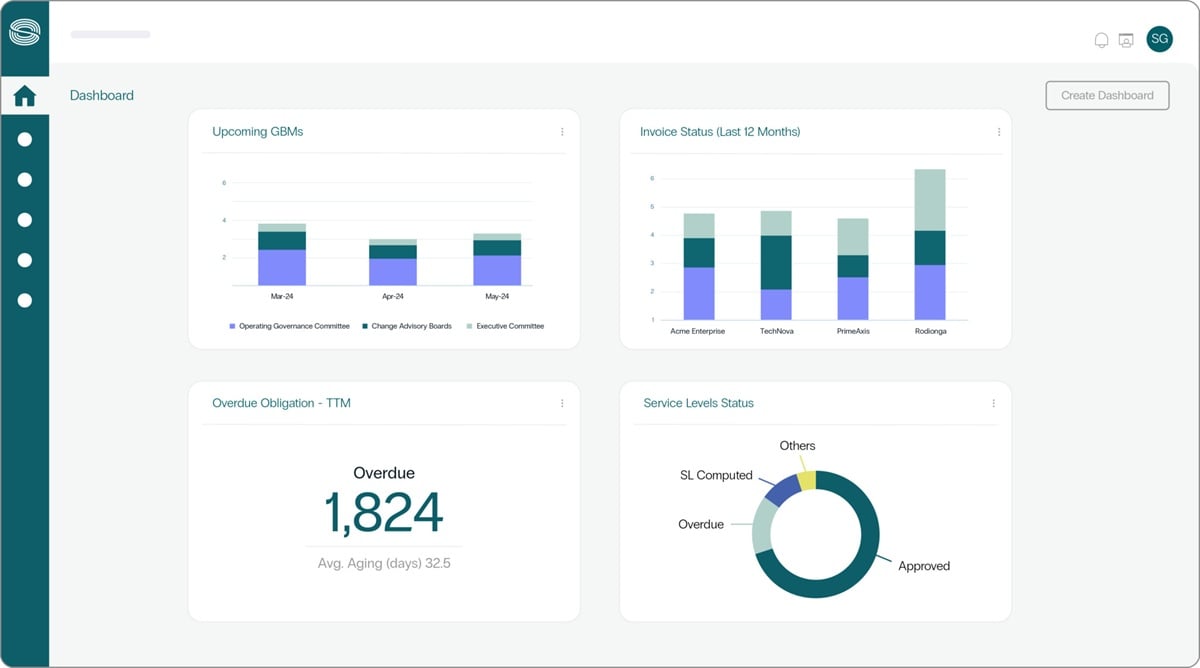
Sirion CLM is an AI-native contract lifecycle management platform designed to help enterprises efficiently manage complex contracts and supplier relationships. With a focus on contract performance, compliance, and risk mitigation, Sirion CLM enables businesses to track contract obligations, monitor performance, and ensure that all parties meet their contractual commitments.
Known for its suite of AI agents—including AskSirion, Extraction Agent, Redline Agent, and IssueDetection Agent—Sirion automates core contracting tasks, resulting in 60% faster contract reviews and faster turnaround times (TAT).
Core Features of Sirion CLM
- AskSirion: Helps easily retrieve contract details by simply asking questions in natural language. Provides instant answers to contract queries, helping teams quickly access critical contract information without legal expertise.
- Extraction Agent: Automatically pulls key contract data, such as clauses, dates, and obligations, from contract documents.
- Contract Insights: Provides real-time analysis of your contracts, identifying risks, compliance gaps, and opportunities. Helps monitor performance and take proactive action to stay ahead of issues.
- Collaboration: Helps collaborate on CLM by allowing multiple stakeholders to edit, review, and approve contracts in real-time. Ensures version control and smooth communication, speeding up contract negotiations and approvals.
Pros and Cons of Using Sirion CLM
Here are the pros and cons of using Sirion CLM based on user reviews and feedback collected from Capterra and G2:
| Pros | Cons |
| Conversational AI simplifies contract lifecycle automation. | Feature limitations when migrating contracts from one folder to another. |
| Offers contract-wise obligation tracking and deliverable status management. | Implementation complexity for smaller businesses or teams with limited resources. |
| Scalable and suitable for large enterprises with complex contract portfolios. | Can be expensive, especially for smaller organizations looking for more basic CLM solutions. |
| AI-driven insights help mitigate risks and ensure compliance. |
This concludes our list of the 10 best contract management platforms. However, with most of these tools offering similar CLM software pricing options, features, and AI capabilities, the question remains: How do you choose the right one for your business? Let’s break it down.
How to Choose the Right Contract Management Software
We’ve covered the strengths, features, pros, and cons of the industry’s top contract management software. But on a business level, there are a few key factors to consider to ensure you find the perfect product fit. Here are the aspects you should focus on:
1. Core Features and Functionalities
- Ensure core contract management software features, including contract creation, negotiation, approvals, signing, storage, and renewal tracking.
- Look for AI-powered clause suggestions and pre-approved templates to streamline contract drafting.
- Verify if it offers compliance tracking, audit logs, and obligation management to reduce legal risks.
2. Ease of Use and User Adoption
- Choose a platform with an intuitive interface and minimal learning curve.
- Check if the vendor provides onboarding support, training materials, and customer assistance.
- Opt for self-serve contract workflows that non-technical users can manage easily.
3. AI and Automation Capabilities
- Prioritize platforms that offer AI-based features and functionalities for CLM automation.
- Ensure that your CLM has features to automate core processes like generation, workflows, and review.
- Look for natural language search to quickly retrieve contract clauses and obligations.
- Platforms like Aavenir offer complete lifecycle automation for end-to-end contracting efficiency.
Make Contracting Faster, Smarter, and Risk-Free With AI
Automate repetitive processes and increase efficiency with Aavenir—the AI-led contract management software for smart businesses.
4. Integration Options
- Look for platforms offering integrations with CRMs (Salesforce, HubSpot), ERPs (SAP, Oracle), and eSignature tools (DocuSign, Adobe Sign).
- Ensure seamless data synchronization between procurement, finance, and legal teams.
- Look for API-based or drag-and-drop integrations for flexibility.
- For complex configurations or integrations in proprietary tools, prefer open-source platforms.
5. Customizability
- Choose a solution that allows you to customize workflows, templates, and approval processes.
- Ensure role-based access controls so different teams can work securely.
- Check if the platform adapts to industry-specific compliance needs.
6. Cost Feasibility and Pricing
- Compare pricing models: per user, per contract, or enterprise licensing.
- Check for hidden costs like implementation, API access, and premium support.
- Ensure scalability so the software remains cost-effective as your business grows.
- Opt for a free trial or a free version before investing in a platform.
Now that you know what to look for in a contract management platform, all you need to do is evaluate the platforms listed above and pick the one that ticks the right boxes for your business.
Set Contracts on Auto-Pilot with Aavenir Contractflow
Selecting the right contract management software can be a challenge. With so many options offering a range of features, integration possibilities, customization levels, and pricing plans, it’s not always easy to find the right fit for your unique requirements.
That’s where Aavenir Contractflow stands out. It removes the complexity from contract management by automating the entire process—from drafting and approvals to tracking and compliance.
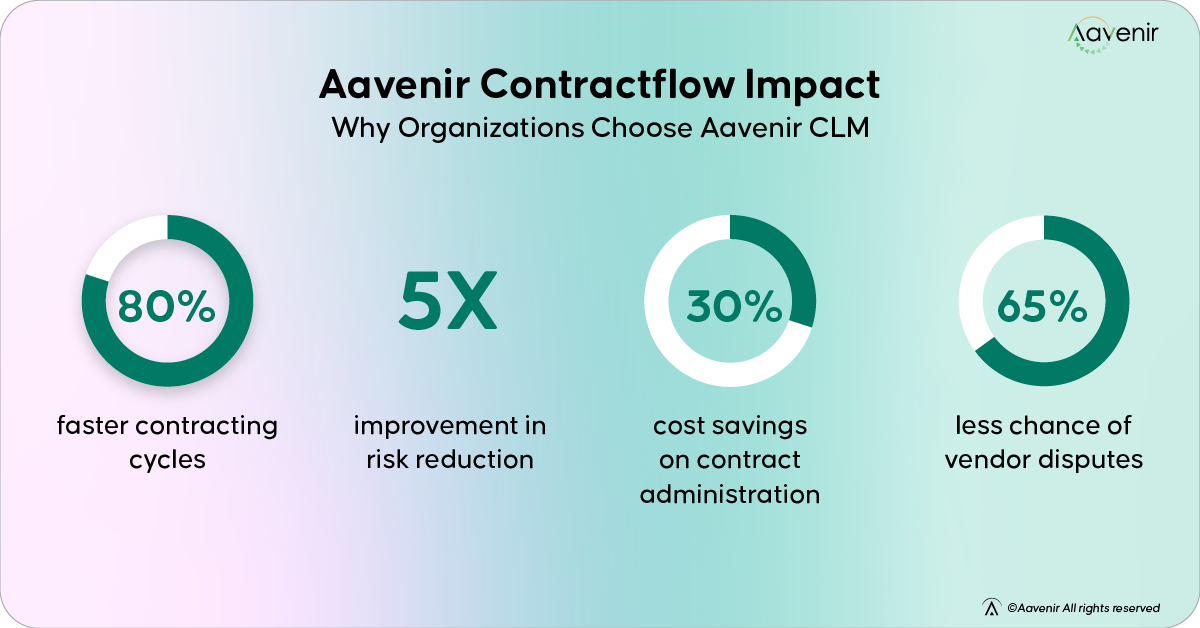
With AI-powered insights, smart workflows, and seamless integrations, Aavenir makes contract management effortless. Here’s what using Aavenir Contractflow looks like:
- 80% faster contracting cycles
- 5X improvement in risk reduction
- 30% cost savings on contract administration
- 65% less chance of vendor disputes
Want to know more? Book a free demo for Aavenir Contractflow today and discover a smarter, faster, and more reliable way to handle your contracts.
Frequently Asked Questions
Do small-scale businesses and startups also need contract management software?
Yes, small-scale businesses and startups also need contract management software. As businesses grow, managing contracts manually becomes time-consuming and error-prone. Contract management software streamlines processes, ensures compliance, and helps track important contract milestones, which can be crucial for small-scale busineses.
Which contract management platforms are best for enterprise companies?
For enterprise companies, platforms like Aavenir, Icertis, Ironclad, and Agiloft are ideal. These solutions offer advanced features, such as AI-powered contract analytics, robust compliance tracking, and scalable integrations that can handle complex workflows and large volumes of contracts. They are built to support the needs of large teams and comply with global regulatory standards.
How do I evaluate if a contract management solution is right for my business?
To evaluate if a contract management solution fits your business, consider core features like automation, eSignatures, and reporting. Check if it integrates with your existing tools, such as CRMs or ERPs. Consider ease of use—the software should be intuitive for your team to adopt quickly.
Also, evaluate pricing to ensure it fits your budget while providing scalability as your business grows. Finally, look for customer support options and security features to protect sensitive contract data.