
RFP software helps procurement and sourcing teams create, issue, manage, evaluate, and award requests for proposals in a structured digital workflow rather than through disconnected spreadsheets, inboxes, shared folders, and manual scorecards.
Choosing the right RFP software is no longer only about sending questionnaires to suppliers. Buyers need a system that can standardize sourcing events, reduce manual coordination, improve supplier response quality, protect evaluation integrity, connect sourcing data to downstream contracts, and give leadership visibility into cycle times, participation, savings, and award decisions.
In 2026, the strongest RFP Management software combines workflow automation, configurable templates, supplier collaboration, weighted scoring, reporting, auditability, integrations, and AI-assisted productivity. For organizations already using ServiceNow, the question is also whether a standalone sourcing tool creates another data silo or whether RFP management can operate within the same enterprise workflow platform.
Key Takeaways
- Structured authoring and reusable templates reduce the effort required to launch repeatable RFx events.
- Supplier collaboration and controlled Q&A improve response quality while maintaining fairness and an audit trail.
- Weighted scoring and side-by-side comparisons help stakeholders make more consistent, defensible supplier-selection decisions.
- ServiceNow-native workflow and integrations can reduce duplicate data entry and connect sourcing to contracts, vendor onboarding, risk, and procurement operations.
What Are the Most Important RFP Software Features?
The following RFP software features matter most when evaluating a sourcing platform.
- Configurable RFx templates and questionnaire libraries
- Collaborative RFP authoring
- Supplier invitation and response management
- Supplier Q&A and communication controls
- Evaluation scorecards and weighted scoring
- Side-by-side bid comparison
- Workflow automation and approvals
- Milestone, deadline, and notification management
- Reporting and sourcing analytics
- Audit trails, governance, and role-based access
- Supplier data and risk integration
- Contract and award handoff
- ServiceNow-native architecture and enterprise integration
- AI-assisted content reuse and sourcing productivity
RFP Software Feature Evaluation Checklist
Use this table to compare RFP software vendors during shortlisting and demos.
|
RFP Software Capability |
What to Look For |
Why It Matters |
Evaluation Question |
|
RFx templates |
Configurable templates for RFPs, RFQs, RFIs, and category-specific sourcing events |
Reduces time spent recreating standard content |
Can business users create and reuse templates without IT support? |
|
Question library |
Central, reusable question bank with categories and version control |
Improves consistency across sourcing events |
Can we reuse approved questions and retire outdated ones? |
|
Collaborative authoring |
Multiple internal contributors, comments, task assignment, and review workflows |
Prevents authoring delays and fragmented requirements |
Can procurement, legal, IT, and business teams collaborate in one workspace? |
|
Supplier invitations |
Controlled supplier lists, invitation workflows, reminders, and participation tracking |
Reduces manual follow-up and missed supplier responses |
Can the system track accepted, declined, pending, and submitted responses? |
|
Supplier portal |
Secure supplier experience for access, response completion, and document uploads |
Makes it easier for suppliers to participate accurately |
Can suppliers complete responses without relying on email attachments? |
|
Q&A management |
Centralized supplier questions, controlled answers, and shared clarifications |
Improves fairness and avoids inconsistent answers |
Can the buyer publish one answer to all eligible suppliers? |
|
Response validation |
Required fields, mandatory attachments, deadline controls, and submission checks |
Improves completeness before evaluation starts |
Can incomplete or late proposals be identified automatically? |
|
Weighted scoring |
Configurable scoring criteria, evaluator assignments, and weighting |
Supports objective and transparent decisions |
Can different criteria carry different weights by sourcing event? |
|
Side-by-side comparison |
Comparable supplier responses, pricing, scores, and supporting evidence |
Helps evaluators identify differences faster |
Can evaluators compare supplier responses question by question? |
|
Workflow automation |
Routing, approvals, escalation rules, and task reminders |
Reduces coordination work and approval bottlenecks |
Can workflows adapt by category, spend threshold, geography, or risk? |
|
Reporting and dashboards |
Cycle time, supplier response rate, savings, event volume, and award analysis |
Gives leaders visibility into sourcing performance |
Can dashboards be filtered by category, region, business unit, and supplier? |
|
Audit trail |
Time-stamped actions, communications, approvals, and scoring history |
Supports governance, audit, and dispute resolution |
Can the system show who changed, approved, scored, or communicated what? |
|
Contract handoff |
Conversion of award data into contract requests or agreements |
Prevents rekeying between sourcing and contracting |
Can awarded supplier data flow directly into the contracting process? |
|
Integrations |
ERP, vendor master, CLM, risk, identity, BI, and collaboration tools |
Reduces data silos and manual uploads |
Which integrations are native, configurable, or custom? |
|
Platform architecture |
Enterprise security, role-based access, data model alignment, and extensibility |
Determines long-term scalability and governance |
Does the product create another isolated sourcing database? |
1. Configurable RFx Templates and Questionnaire Libraries
The first feature to evaluate is whether the software helps teams launch sourcing events quickly without sacrificing control.
Procurement teams often repeat the same work across categories: building supplier questionnaires, recreating response instructions, formatting spreadsheets, defining evaluation criteria, and collecting approvals. A reusable template and question library can reduce this repetitive effort while still allowing category-specific tailoring.
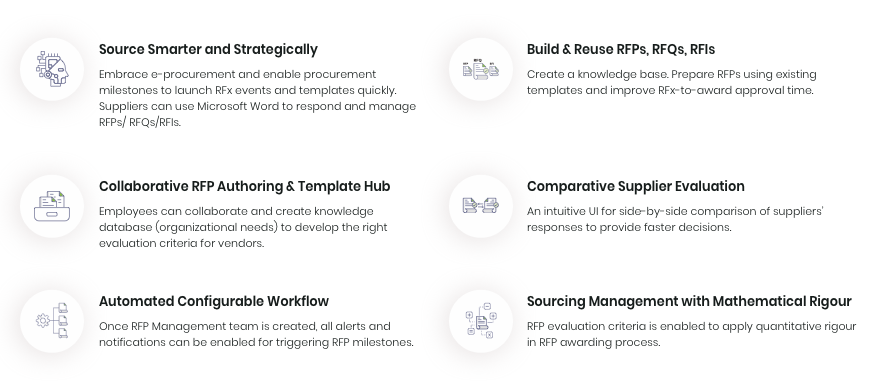
Aavenir RFPflow provides configurable RFx templates and questionnaire libraries so sourcing teams can create RFPs, RFQs, and RFIs using standardized content rather than starting from a blank document each time. Aavenir states that teams can prepare 50% to 70% of an RFx in minutes by reusing question libraries, templates, and collaborative sourcing tools.
Look for software that supports:
- Category-specific RFP templates
- Reusable supplier questions
- Mandatory, optional, and conditional questions
- Version-controlled questionnaire content
- Template approval workflows
- Reusable scoring models
- Standard pricing sheets and compliance declarations
2. Collaborative RFP Authoring
RFPs are rarely authored by procurement alone. Business owners define the need, IT contributes technical requirements, security adds risk questions, legal reviews commercial terms, finance provides pricing requirements, and executive stakeholders may need approval before issue.
RFP software should make this collaboration visible and controlled rather than forcing teams to circulate multiple versions of a document through email.
Aavenir RFPflow supports collaborative RFP authoring through ServiceNow workflows, allowing procurement and business stakeholders to create, review, and manage sourcing-event content in one connected environment.
Buyers should evaluate whether users can:
- Assign ownership for individual sections
- Add comments and clarification requests
- Track open actions and overdue tasks
- Manage approvals before publishing
- Preserve version history
- Prevent conflicting offline document edits
3. Supplier Invitation and Response Management
Supplier participation is one of the most important measures of RFP success. A sourcing event cannot produce a strong commercial or strategic outcome if qualified suppliers do not receive, understand, or complete the request.
The right RFP software should manage supplier invitations, track participation, send reminders, collect documents, and provide visibility into response status.
Aavenir RFPflow enables teams to manage supplier invitations, collect vendor responses, and monitor sourcing-event activity from within a centralized RFP management workflow.
Key capabilities to assess include:
- Supplier list creation and approval
- Secure invitation delivery
- Supplier acceptance or decline tracking
- Automated reminders
- Response-status monitoring
- Attachment and document collection
- Submission deadline controls
- Supplier participation reporting
4. Supplier Q&A and Controlled Communication
Unmanaged supplier communication can undermine fairness and create unnecessary risk. When suppliers ask questions by email, different answers may be shared with different parties, responses may be lost, and procurement may struggle to maintain a complete record.
RFP software should centralize supplier questions and allow procurement to publish clarifications consistently.
Aavenir RFPflow supports supplier response collection and sourcing-event collaboration through controlled workflows, helping procurement teams maintain a clearer record of supplier communications and sourcing activities.
During demos, ask vendors whether the system can:
- Capture supplier questions in one place
- Route questions to internal subject matter experts
- Publish approved answers to all participating suppliers
- Restrict visibility where confidentiality is required
- Preserve a time-stamped communication history
- Lock communications after a deadline or award decision
5. Evaluation Scorecards and Weighted Scoring
Supplier selection should be based on a defined evaluation framework rather than unstructured opinion. The most useful RFP software supports configurable scoring criteria, evaluator assignments, weighted scores, comments, and approval controls.
Weighted scoring is particularly important when the selection depends on more than price. For example, a technology RFP may weigh functional capability, integration fit, security, implementation approach, customer references, service model, and total cost of ownership differently.
Aavenir RFPflow enables internal stakeholders to provide quantitative scores for supplier responses, calculates weighted scores based on the questionnaire setup, and supports structured evaluation workflows.
Evaluate whether the platform can support:
- Multiple scoring criteria
- Weighted evaluation categories
- Individual evaluator scoring
- Restricted evaluator visibility
- Consensus scoring or calibration sessions
- Mandatory evaluator comments
- Scoring deadlines and reminders
- Conflict-of-interest declarations
- Approval of final scores before award
6. Side-by-Side Supplier Response Comparison
A supplier proposal is only useful when internal teams can compare it efficiently. Manually moving responses into spreadsheets is time-consuming and can introduce errors or omit context.
RFP software should provide side-by-side comparisons of supplier responses, pricing, compliance answers, scores, documents, and key differences.
Aavenir RFPflow provides side-by-side vendor response comparison and consolidated evaluation views so stakeholders can assess suppliers at both a high level and question-by-question level.
This feature is especially valuable when:
- Many suppliers respond to the same questionnaire
- Multiple business stakeholders are evaluating proposals
- There are large pricing workbooks or technical response documents
- Procurement needs to identify non-compliant responses quickly
- Leadership needs a concise decision summary
7. Workflow Automation and Approval Controls
RFP processes involve many decisions: approval to launch, approval of supplier lists, review of questionnaire content, supplier qualification, evaluation completion, award recommendation, and final contracting approval.
Without workflow automation, these steps become dependent on email follow-up and informal tracking. That creates delays and makes it difficult to understand where an event is blocked.
Aavenir RFPflow uses ServiceNow workflows to automate sourcing tasks, milestone management, approvals, and notifications across the RFP lifecycle.
Look for workflow capabilities such as:
- Spend-threshold approval routing
- Category-specific approval paths
- Escalations for overdue actions
- Automated reminders
- Conditional workflow logic
- Approval delegation
- Separation of duties
- Workflow audit history
8. Milestone, Deadline, and Notification Management
RFP delays often happen because teams lose track of dates: finalizing requirements, publishing the event, responding to supplier questions, completing evaluations, conducting demos, and obtaining award approvals.
Good RFP software should make timelines visible and actively notify users when action is needed.
Aavenir RFPflow enables procurement teams to define milestones, track sourcing activities, and use workflow notifications to keep internal stakeholders and suppliers aligned on key dates.
Evaluate whether the software can track:
- RFP issue date
- Supplier question deadline
- Proposal submission deadline
- Evaluation window
- Shortlist and demo dates
- Negotiation timeline
- Award approval date
- Contracting handoff date
- Post-event lessons learned
9. Reporting and Sourcing Analytics
RFP software should not only manage individual events. It should help procurement leaders understand sourcing performance across categories, business units, regions, and suppliers.
The most useful reporting focuses on operational metrics and decision quality, including cycle time, response rate, supplier participation, evaluation completion, savings, sourcing volume, award outcomes, and bottlenecks.
Aavenir RFPflow supports tracking of sourcing-event KPIs such as vendor response rates, savings, and time-to-award through ServiceNow-based reporting and workflow data.
Useful metrics to measure include:
- Average time from request to award
- Time spent in drafting, supplier response, evaluation, and approval
- Supplier response rate
- Number of qualified bidders per event
- Evaluator completion rate
- Savings achieved or avoided cost
- Event volume by category
- Award concentration by supplier
- Number of late or incomplete responses
- RFP rework rate
10. Audit Trails, Governance, and Role-Based Access
For strategic, regulated, or high-value purchases, procurement must be able to explain how and why a supplier was selected.
An RFP software platform should retain a clear record of sourcing-event changes, supplier communications, evaluator input, scoring decisions, approvals, and award outcomes.
Aavenir RFPflow is built on ServiceNow, enabling role-based access, workflow history, and centralized sourcing records that support governance and auditability.
Ask vendors how they handle:
- Role-based access controls
- Supplier confidentiality
- Evaluator access restrictions
- Approval history
- Change logs
- Evidence retention
- Data export controls
- Audit reporting
- Conflict-of-interest workflows
11. Supplier Data and Risk Integration
A supplier should not be evaluated only on its RFP answers. Procurement teams increasingly need visibility into supplier risk, compliance status, financial information, security posture, onboarding records, and contract history.
Standalone RFP tools often require teams to export supplier data and manually reconcile it with vendor-management, risk, or onboarding systems.
Aavenir RFPflow can collect supplier responses and update supplier information within ServiceNow environments, including use cases that connect sourcing data with ServiceNow GRC and vendor-related workflows.
This is important for buyers that need to evaluate:
- Security questionnaires
- Financial risk information
- Regulatory certifications
- Diversity or ESG credentials
- Insurance documentation
- Supplier onboarding readiness
- Historical performance
- Existing contract relationships
12. Contract and Award Handoff
The award decision is not the end of the sourcing lifecycle. The selected supplier still needs to move into contracting, onboarding, implementation, and performance management.
A major weakness of many RFP systems is that award information must be manually re-entered into a contract lifecycle management platform or procurement system.
Aavenir RFPflow supports a connected source-to-contract approach by helping organizations move from sourcing events to awarded supplier relationships and executable contracts within the broader Aavenir platform.
Buyers should assess whether the platform can:
- Create a contract request from an award
- Transfer supplier and pricing data
- Preserve source documents and evaluation records
- Link award decisions to contracts
- Trigger vendor onboarding activities
- Track implementation obligations after award
13. ServiceNow-Native vs. Standalone RFP Software
The architecture of RFP software matters as much as the feature list.
Standalone RFP software can provide focused sourcing functionality, but it may create a separate supplier database, separate workflow engine, separate reporting layer, and separate integration requirement.
ServiceNow-native RFP software can offer a more connected operating model for organizations already using ServiceNow for procurement, legal, IT, risk, vendor management, or employee workflows.
|
Area |
ServiceNow-Native RFP Software |
Standalone RFP Software |
|
Workflow |
Uses the existing ServiceNow workflow and approval framework |
Often uses a separate workflow engine |
|
Data model |
Can connect to existing ServiceNow records and processes |
Usually creates another sourcing data repository |
|
Reporting |
Can use ServiceNow reporting and dashboards |
May require separate reporting tools or exports |
|
Integration |
Can connect more directly with ServiceNow-based processes |
May require APIs, middleware, or file-based integration |
|
User experience |
Can align with the ServiceNow portal and user identity model |
Introduces a separate interface and user administration layer |
|
Governance |
Can leverage existing ServiceNow roles, audit controls, and security policies |
Requires separate governance and access administration |
|
Source-to-contract flow |
Can connect sourcing to contract, onboarding, risk, and service workflows |
Often requires handoffs across multiple applications |
|
Total operating model |
Supports consolidation for ServiceNow-centric organizations |
Can add another specialized application to manage |
Aavenir RFPflow is RFP software built on ServiceNow, designed to help procurement teams manage sourcing events while connecting supplier collaboration, evaluation, award workflows, and downstream source-to-contract processes.
14. AI-Assisted Content Reuse and Sourcing Productivity
AI can improve RFP productivity, but buyers should evaluate it carefully. The most useful AI capabilities are usually practical: finding approved questions, suggesting reusable content, summarizing supplier responses, identifying missing answers, highlighting response differences, and helping teams prepare evaluation summaries.
AI should not replace sourcing judgment. It should reduce repetitive work and make information easier to analyze.
Aavenir RFPflow supports structured RFx creation through reusable templates, question libraries, and configurable workflows. For AI-specific capabilities, buyers should ask how the vendor manages source grounding, review workflows, user permissions, auditability, and human approval before generated content influences a sourcing decision.
RFP Software Statistics and Benchmarks to Consider
RFP performance varies significantly by category, supplier market, complexity, regulatory requirements, internal approval structure, and contract value. There is no universal benchmark that applies to every sourcing event.
However, the following figures illustrate why workflow, automation, and evaluation discipline matter:
- Aavenir states that sourcing teams can prepare 50% to 70% of an RFx in minutes when they use reusable templates, question libraries, and collaborative RFx tools.
- A U.S. Government Accountability Office review of Department of Defense contract data found that procurement administrative lead time is tracked from solicitation through award for significant contracts, showing why procurement teams should measure the complete sourcing cycle rather than only proposal-submission time.
- World Bank procurement guidance defines bid evaluation time as the number of days between bid opening and completion of evaluation, reinforcing that evaluation is a measurable stage that should be monitored independently.
- Public-sector procurement research cited by the World Bank has found bid-opening-to-evaluation periods ranging from roughly two to three months to nearly a year in some settings, illustrating how governance, complexity, and process design can materially affect procurement timelines.
The practical lesson is simple: establish your own baseline for drafting time, supplier response rate, evaluator completion, evaluation duration, award cycle time, and sourcing savings. Then use RFP software to improve those measures over time.
RFP Software Buyer Questions to Ask Vendors
Use these questions during vendor demos, technical validation, and commercial evaluation.
- Can procurement users create, edit, approve, and publish RFP templates without relying on IT or professional services?
- How does the platform manage supplier invitations, supplier questions, reminders, late submissions, and response completeness?
- Can evaluators score supplier responses independently using weighted criteria and mandatory comments?
- How are supplier responses compared side by side, including pricing, compliance answers, documents, and evaluation scores?
- Can the solution support different sourcing workflows by spend threshold, region, category, risk rating, or business unit?
- What sourcing-event data can flow into contract management, vendor onboarding, supplier risk, ERP, and analytics platforms?
- Does the solution provide a complete audit trail for changes, supplier communications, approvals, evaluator activity, and award decisions?
- How does the platform handle role-based access, supplier confidentiality, evaluator access restrictions, and conflict-of-interest controls?
- Which integrations are native, which are configurable, and which require custom development or middleware?
- How does the vendor measure implementation success after go-live, including adoption, cycle time, supplier response rate, evaluation completion, and savings visibility?
How to Choose RFP Software?
The best RFP software is not necessarily the platform with the longest feature list. It is the platform that fits the organization’s sourcing process, governance model, integration environment, supplier ecosystem, and broader procurement technology strategy.
When evaluating RFP software, prioritize:
- Ease of adoption for procurement, stakeholders, and suppliers
- Configurability without constant IT dependency
- Supplier collaboration and response quality
- Evaluation consistency and decision transparency
- Reporting and measurable sourcing outcomes
- Integration with contracts, vendor management, risk, and ERP
- Security, auditability, and enterprise governance
- Long-term platform fit rather than isolated point functionality
For ServiceNow-centric organizations, a ServiceNow-native RFP solution can reduce fragmentation by connecting sourcing workflows with the systems teams already use to manage contracts, suppliers, risk, approvals, and enterprise service delivery.
Frequently Asked Questions About RFP Software
What is RFP software?
RFP software is a digital platform that helps procurement teams create, issue, manage, evaluate, and award requests for proposals. It centralizes supplier communications, response collection, scoring, approvals, reporting, and sourcing-event records.
What are the most important RFP software features?
The most important RFP software features include reusable templates, supplier collaboration, controlled Q&A, response management, weighted scoring, side-by-side comparisons, workflow automation, reporting, audit trails, integrations, and contract handoff.
How does RFP software improve supplier evaluation?
RFP software improves supplier evaluation by standardizing questionnaires, assigning weighted scoring criteria, capturing evaluator feedback, comparing supplier responses side by side, and preserving an auditable selection record.
What is the difference between RFP software and eSourcing software?
RFP software focuses specifically on managing RFP, RFQ, and RFI events. eSourcing software may include broader capabilities such as auctions, spend analysis, supplier discovery, supplier management, contract management, and procurement analytics.
Should RFP software integrate with contract management software?
Yes. RFP software should ideally connect to contract management so award decisions, supplier information, pricing, supporting documents, and negotiated commitments do not need to be manually re-entered after supplier selection.
Why choose ServiceNow-native RFP software?
ServiceNow-native RFP software can help organizations use existing ServiceNow workflows, security controls, reporting, user roles, and connected enterprise processes instead of introducing another separate sourcing platform and data silo.
Simplify RFP Management With Aavenir RFPflow
Aavenir RFPflow helps procurement teams standardize and manage RFPs, RFQs, and RFIs through ServiceNow-native workflows. It supports collaborative RFx authoring, configurable templates, supplier response management, weighted evaluation, side-by-side comparisons, approvals, milestones, sourcing analytics, and connected source-to-contract processes.
For procurement organizations looking to reduce manual coordination without adding another disconnected application, Aavenir RFPflow provides a structured way to manage sourcing events from initial request through supplier award.