
Use case · Obligation tracking
Are we meeting what we signed, with evidence to show for it?
Obligationflow lists every obligation in a signed contract, routes each one to an owner with a due date, and tracks it with reminders and escalations. The owner attaches the evidence, and a person reviews it and closes the task. When an auditor asks, you hand over a record, not a reminder log.
Definition
What is contract obligation tracking?
Contract obligation tracking is the practice of listing what each party must do under a signed contract, such as pay, report, insure or give notice, assigning each item a named owner and date, and keeping proof it was done.
A reminder tells someone a report is due, and that is often where tracking ends. In Obligationflow the task runs to closure: the owner attaches the certificate, certification or report to the obligation record, reminders and escalations follow it until it is in, and a person reviews it before closing the task.
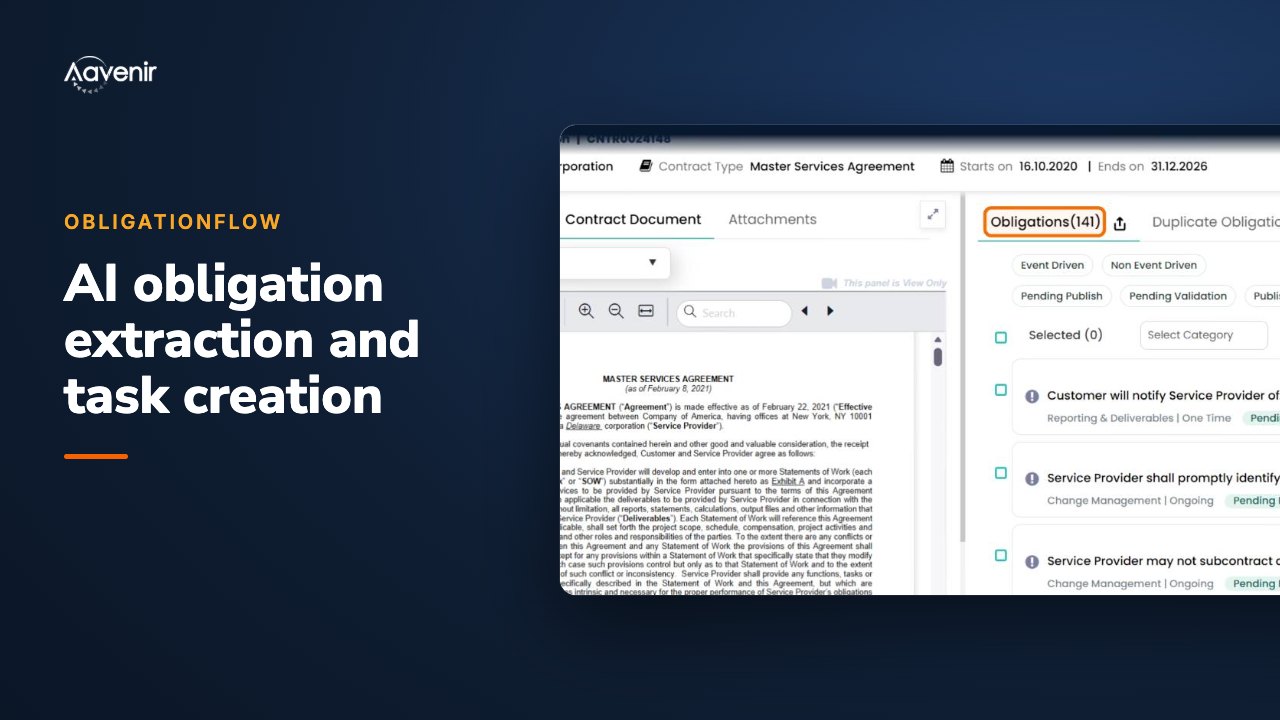
- Aavenir AI extracts obligations by category, with frequency and event triggers
- The contract manager reviews the list before any task exists
- Assignment rules route each obligation to a person or team
- Owners reply to a due date email, and the evidence files itself
- A person reviews the attached evidence and closes or rejects the task
Why it leaks
Four places obligations fall through.
Never extracted
The obligation sits on page 31 of a schedule, so it never reaches a tracker.
No single owner
Legal signed it, operations runs the supplier, and each assumes the other is watching.
Reminders without proof
The calendar alert fires, someone replies done, and nothing is filed.
Evidence nobody can find
A certificate arrives, gets saved in an inbox, and nobody can produce it at audit.
How it works
One staffing contract, from PDF to a closed task.




-
Obligations grouped by category, each with a frequency Event triggered obligations flagged, such as exit assistance Nothing becomes a task until the contract manager accepts the list.
-
Route by category, supplier or any field to a person or a team Recurring obligations become a dated series of tasks Obligations not written in the contract come from the library or an Excel upload.
-
On the due date the owner receives the obligation and its clause A reply with the evidence attached lands on the right task Owners and reviewers discuss it on the task, so the history stays put.
-
The evidence sits on the obligation record, next to its clause The reviewer closes or sends it back, with reasons on the record Overdue items escalate to the next person in one click.
Watch
See it in the product.
 0:51
Customer results
What customers report once obligations have owners.
Questions
Talk to a contract expert
Bring a few sample agreements. We will show you Aavenir AI reading them, on ServiceNow or standalone.
Schedule a Demo
Frequently asked questions (FAQ)
Common questions
How do you track contract obligations?
List every obligation in the signed contract with its category, frequency and trigger, give each one an owner and a due date, and keep the evidence that it was met. Obligationflow does the listing with Aavenir AI, routes tasks by rules, sends reminders and escalations, and a person reviews the evidence before the task closes. See Obligationflow.
What is the difference between obligation tracking and contract management?
Contract management runs the agreement from request to signature and renewal. Obligation tracking manages the commitments inside the signed agreement, such as reports, certificates and notices, until each is met and closed. Aavenir runs both on one record, so obligations come straight from the executed contract. See Contractflow.
Who confirms that an obligation was met?
A person. Aavenir AI extracts and classifies the obligations, and Obligationflow assigns and tracks them. The owner attaches the certificate, certification or report to the obligation record, and a reviewer checks it and closes or rejects the task, with reasons kept on the record. See Obligationflow.
Can we track obligations that are not in the contract?
Yes. Add them from the obligation library, create them by hand, or upload them in bulk from Excel. They get owners, due date emails and evidence on the record like any obligation Aavenir AI extracted, which suits policy duties and regulatory reporting. See third party risk and DORA.
Have a question we have not answered? Ask the Expert
Schedule a demo
See your contracts run on one record.
- 1 A 30-minute walkthrough Built around your team, whether that is procurement, legal, IT or finance.
- 2 Your contracts, not ours Bring a few sample agreements and watch Aavenir AI extract and review them.
- 3 ServiceNow or standalone We show the deployment that fits the systems you already run.
Prefer to talk first? Contact the team.
The form did not load. Contact the team instead, or refresh the page.