
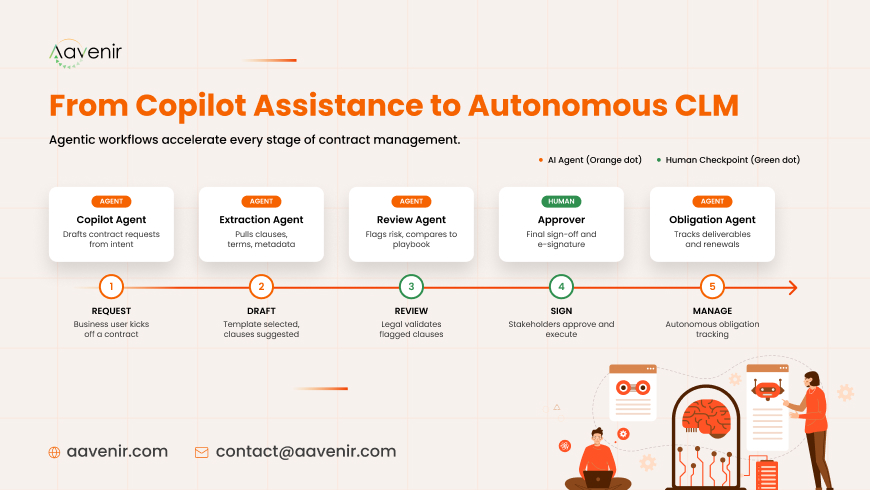
Agentic AI contract management is redefining how enterprises create, negotiate, and manage contracts across legal, procurement, sales, and finance. Instead of simply answering prompts, agentic AI coordinates specialized AI agents that can plan, act, and adapt across the entire contract lifecycle with clear business goals in mind.
For enterprise leaders evaluating AI-native CLM – especially on ServiceNow – this shift is critical: it marks the move from “AI as a sidecar copilot” to autonomous but governed contract operations built into your core workflows. In this post, we’ll unpack what agentic AI in contract management really means, how it differs from copilot-style tools, the concrete roles of contract AI agents, the guardrails required for autonomy, why ServiceNow-native deployment matters, and the measurable outcomes you should expect.
Key Takeaways:
- Agentic AI contract management moves beyond simple copilots by enabling autonomous AI agents to execute multi-step contract workflows with governance and oversight.
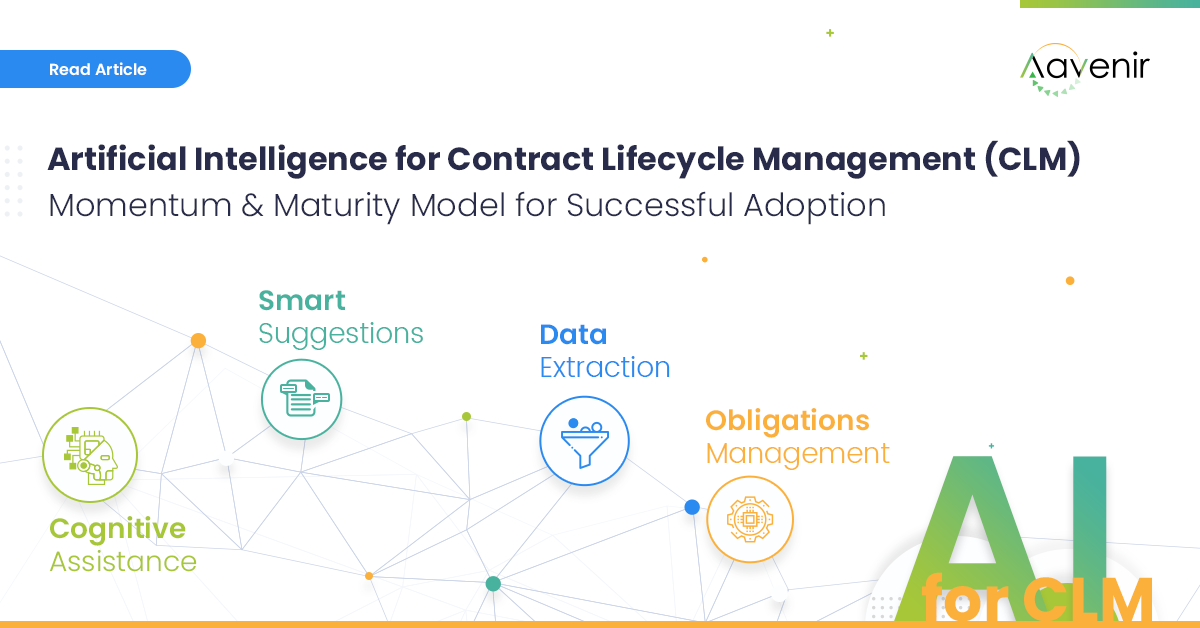
- AI agents can support every stage of the contract lifecycle, including contract extraction, review, negotiation support, obligation tracking, renewal management, and compliance monitoring.
- Unlike reactive AI assistants, agentic systems proactively trigger actions, route approvals, monitor risks, and orchestrate workflows across legal, procurement, finance, and sales operations.
- Human oversight, approval checkpoints, audit trails, and policy-based guardrails remain essential for enterprise adoption of autonomous contract operations.
- A ServiceNow-native CLM platform strengthens agentic AI capabilities by unifying workflows, security, governance, and enterprise data in a single operational ecosystem.
- Organizations adopting agentic AI contract management can reduce contract cycle times, improve compliance, minimize missed obligations, and scale legal operations without proportional headcount growth.
- The future of CLM is shifting from isolated AI assistance toward orchestrated, outcome-driven autonomous contract operations powered by specialized AI agents.
What Agentic AI Contract Management Really Means
At its core, agentic AI contract management is about AI systems that perceive context, reason goals, and take actions across multiple steps of the contract lifecycle-not just automate a single task. Traditional AI in CLM focused on narrow jobs such as clause extraction or basic analytics; agentic AI goes further by planning, acting, and learning in a loop.
In practice, that means AI agents that: read and interpret contracts, compare terms to policies, trigger workflows, and follow through until a business outcome is reached, like a signed agreement, a renegotiated renewal, or a resolved compliance risk. These agents operate within an agentic, AI-powered contract lifecycle management environment where they can access contract repositories, playbooks, CRM/ERP data, and risk systems to make informed decisions.
The emphasis is on autonomy and orchestration: AI agents are not just passive responders; they are proactive workers that keep agreements on track – watching dates, obligations, and risks and acting according to rules you define once.
As enterprises move from isolated AI copilots to autonomous contract operations, the next question becomes practical: what does this actually look like inside a real enterprise CLM platform?
Explore how Aavenir brings AI agents into every stage of the contract lifecycle, from contract review and compliance screening to obligation management and workflow orchestration.
Agentic AI CLM vs Copilot-style AI
Most organizations started their AI journey in CLM with copilot-style tools: generative assistants embedded in editors or portals that summarize clauses, rewrite language, or answer questions when prompted. These copilots are valuable, but they are fundamentally reactive: they wait for a user to ask, and they operate within a single step of the process.
By contrast, agentic AI contract management orchestrates multiple AI agents to execute end-to-end workflows across drafting, negotiation, approval, execution, and post‑signature management. For example, an agentic system might automatically analyze third‑party paper, flag risky terms, propose fallback clauses, route the draft for approvals, track delays, and surface renewal options later—without requiring a new prompt at each stage.
Where copilots “assist” humans, agentic AI collaborates with humans and systems to deliver outcomes, with the ability to initiate actions based on triggers like approaching renewals, policy changes, or performance deviations. This is why moving beyond pure copilot models is key for enterprises seeking true autonomous contract management—but always within strong governance.
Key AI Agents for Contract Management
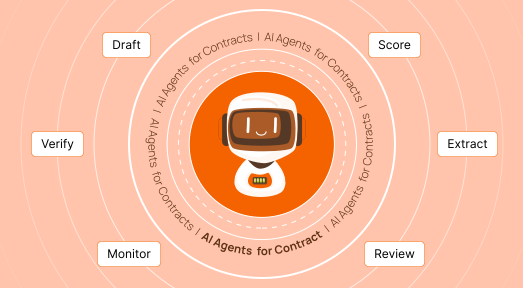
Agentic CLM relies on a constellation of AI agents for contract management, each specializing in a specific domain but working together under a shared framework. Four practical agents are emerging as foundational in modern CLM architectures.
Together, these capabilities make agentic AI contract management a foundational shift from reactive legal operations toward autonomous, workflow-driven CLM.
Extraction Agent
The extraction agent converts unstructured contracts into structured, searchable data at scale.
- Purpose: Turn executed contracts, amendments, and legacy documents into reliable, normalized data for downstream analysis and automation.
- What it does: Ingests contracts, identifies key terms (parties, dates, values, jurisdictions), maps clauses to a taxonomy, and populates fields in your CLM or data warehouse.
- Business problem it solves: Eliminates manual data entry and “repository blindness,” enabling faster answers to questions like “Which contracts renew next quarter?” or “Where do we have non‑standard liability caps?”.
- How it supports teams: Legal, procurement, and RevOps gain instant visibility into portfolio‑wide obligations and commercial terms, supporting better negotiation, forecasting, and compliance.
Review Agent
The review agent acts as a digital contract analyst, aligning drafts to your playbook and risk framework.
- Purpose: Accelerate review while improving consistency with standard language and policies.
- What it does: Scans drafts or counterparty paper, flags deviations from standard clauses, scores risk and suggests compliant redlines based on approved alternatives.
- Business problem it solves: Reduces bottlenecks and variability in review, so legal teams spend less time on routine agreements and more on high‑stakes deals.
- How it supports teams: Negotiators get targeted recommendations; legal ops enforce playbooks; procurement and sales see fewer “ping‑pong” cycles with counterparties.
Vendors deploying such agents report material improvements in throughput, with some indicating contract processing time reductions of up to 50% when AI agents assist with drafting, clause selection, and version tracking.
Obligation Agent
The obligation agent focuses on what happens after signatures: ensuring organizations actually deliver and capture the value they negotiated.
- Purpose: Monitor obligations, SLAs, milestones, and renewals to avoid value leakage and compliance failures.
- What it does: Extracts obligations and key dates, links them to owners and systems, tracks performance data (e.g., uptime, volumes, spend), and triggers alerts or tasks when thresholds are breached or renewals approach.
- Business problem it solves: Reduces missed renewals, penalties, and unclaimed entitlements that arise when obligations are buried in static PDFs.
- How it supports teams: Customer success, obligation management, vendor management, and finance gain proactive visibility into upcoming changes, enabling renegotiations or corrective action before issues escalate.
Copilot / Conversational Assistant
The copilot assistant is the user-facing interface to these agentic capabilities, often delivered as a chat-style experience embedded in your CLM or ServiceNow workspace.
- Purpose: Make AI agents for contracts accessible via natural language, so users don’t need to learn complex query languages or dashboards.
- What it does: Answers questions (“What is the termination notice in this MSA?”), explains clauses in plain English, drafts new agreements, and orchestrates behind-the-scenes agents to run reviews, find similar deals, or check compliance.
- Business problem it solves: Eliminates constant dependence on legal as a bottleneck for basic contract questions, shifting the organization toward self‑service access to contract intelligence.
- How it supports teams: Legal, procurement, sales, and operations all gain a single, conversational entry point to contract data and workflows, regardless of their technical expertise.
Together, these contract AI agents form the backbone of agentic workflows for contract management, with each agent specializing but coordinating through a shared agentic AI layer.
Governance and Guardrails for Autonomous Action
As AI agents become more autonomous, governance and guardrails are non‑negotiable for enterprise adoption. Agentic AI may initiate reviews, route approvals, or even propose redlines, but organizations must define clear boundaries for what agents can and cannot do on their own.
Strong governance frameworks are essential for scaling agentic AI contract management responsibly across enterprise legal and procurement operations.
Effective governance typically includes:
- Human approval checkpoints: Define thresholds (e.g., deal size, jurisdiction, risk score) where human review is mandatory before sending redlines or executing an agreement.
- Role-based permissions: Ensure agents act according to existing approval matrices—who can approve what, under which conditions, and with which financial and risk limits.
- Audit trails: Maintain detailed logs of agent actions, recommendations, and rationale to satisfy audit, regulatory, and internal scrutiny.
- Risk thresholds and escalation: Use scoring models to determine when to escalate clauses, counterparties, or deals to senior legal or compliance stakeholders.
- Policy enforcement: Codify playbooks and standards so agents can enforce them consistently, rather than improvising responses from generic model behavior.
- Explainability and transparency: Provide clear explanations for why an agent flagged risk or suggested certain language, enabling legal teams to validate and tune behavior.
- Data privacy and model governance: Control which data agents can access, how it is used for training or retrieval, and how sensitive information is protected.
Analysts stress that while agentic AI enables more proactive and dynamic CLM, large language models still have limitations on very long or complex contracts, reinforcing the need for human oversight in high‑risk scenarios. The goal is autonomous but governed contract operations not unchecked automation.
These AI agents become significantly more powerful when they operate within a unified contract lifecycle management platform instead of fragmented point solutions. That is where enterprises begin to unlock autonomous, scalable, and measurable contract operations.
Learn how Aavenir helps legal, procurement, and business teams operationalize agentic AI across the entire contract lifecycle.
Why ServiceNow-native Deployment Matters
For many enterprises, ServiceNow is already the backbone for IT, HR, customer service, and increasingly procurement and finance workflows. Deploying AI-native CLM directly on ServiceNow can significantly amplify the power of agentic AI in contract management.
ServiceNow-native deployment helps enterprises operationalize agentic AI contract management within a unified workflow, governance, and data ecosystem.
ServiceNow’s AI platform is evolving from simple assistance toward AI-native, agentic automation, where AI is woven into the platform’s workflow engine rather than bolted on as a separate tool. This means contract AI agents can:
- Leverage a common data model and context engine to understand relationships between contracts, assets, incidents, vendors, and customers.
- Orchestrate workflows that cross modules, such as triggering a vendor risk review, IT onboarding, or customer service entitlement setup when a contract is signed.
- Rely on existing ServiceNow security, identity, and audit capabilities to enforce governance consistently.
A ServiceNow-native CLM avoids the integration friction of standalone tools, where syncing data and workflows between CLM, ITSM, procurement, and CRM can introduce latency, gaps, and duplicate governance layers. Instead, agentic workflows for contract management become first-class citizens in the same platform where other enterprise processes already live—accelerating adoption and making governance simpler to enforce.
Business Outcomes and Measurable Impact
The business value of agentic AI contract management becomes measurable through faster cycle times, reduced legal bottlenecks, and stronger compliance outcomes. For all the technical sophistication, AI agents for contract management must prove their value through measurable business outcomes. Early adopters and vendors report consistent themes in the impact of agentic AI in CLM:
- Faster cycle times: AI agents that automate drafting, clause selection, and version tracking can cut contract processing times by up to 50% in some implementations, turning weeks into days or even hours for standard agreements.
- Reduced legal review effort: By automating first‑pass reviews and flagging only exceptions, legal teams can handle higher volumes without linear headcount growth, reserving expertise for complex negotiations.
- Better clause and policy compliance: Automated checks against playbooks and policies reduce non‑standard terms and hidden exposures that would otherwise slip through manual review.
- Lower risk exposure: Continuous monitoring of obligations, renewals, and risk signals allows earlier interventions, reducing fines, disputes, and reputational damage.
- Fewer missed obligations and renewals: Obligation agents and renewal monitors surface upcoming actions and entitlements, preventing revenue leakage and unintended auto‑renewals.
- Improved cross‑functional alignment: Self‑service access to contract intelligence for sales, procurement, finance, and operations reduces bottlenecks and improves collaboration.
Internally, you can track the impact of agentic contract lifecycle management via KPIs such as: average time from request to signature, percentage of deals using standard clauses, number of escalations per contract type, rate of missed renewals, and volume of contracts handled per FTE in legal and procurement. Over time, compounding gains in speed, risk reduction, and cost efficiency drive a clear ROI story.
A leading BFSI enterprise transformed its contract operations using AI-powered CLM on ServiceNow, achieving 5x faster contract approvals, 100% contract visibility, and a 42% reduction in contract risk exposure.
See how modern, agentic workflows helped streamline approvals, improve governance, and deliver measurable business outcomes across the contract lifecycle.
Conclusion: Turning Agentic AI in Contract Management into an Advantage
Agentic AI in contract management is no longer a distant vision; it is already being deployed by enterprises and CLM providers to deliver proactive, outcome‑driven contract operations. By moving beyond copilot-style assistance to orchestrated AI agents for contracts, organizations can shrink cycle times, tighten risk controls, and unlock self‑service access to contract intelligence across the business. Enterprises that invest early in agentic AI contract management will be better positioned to automate complex workflows while maintaining enterprise-grade governance and control.
For enterprises running on ServiceNow, embracing an AI-native CLM with agentic workflows is a logical next step: it places contract intelligence and automation inside the same platform that already manages requests, approvals, and service delivery. With the right governance, guardrails, and KPIs, agentic AI in contract management becomes a durable competitive advantage, freeing legal and procurement to focus on strategy while AI handles the repetitive, orchestrated work at scale.
Enterprises that operationalize agentic AI in contract management today will be better positioned to reduce operational friction, strengthen governance, and accelerate business velocity tomorrow.
Meet with our experts to see how AI-powered CLM on ServiceNow can help your organization automate contract operations while maintaining enterprise-grade governance and control.
Discover the Aavenir Difference, Book a Demo
Frequently Asked Questions
-
What is agentic AI in contract management?
Agentic AI contract management refers to the use of autonomous AI agents that can perceive context, reason through goals, and execute multi-step contract workflows such as drafting, review, approval routing, obligation tracking, and compliance monitoring with human oversight when needed.
-
How is agentic AI different from a copilot in CLM?
Copilot tools are prompt-driven assistants that help with single tasks such as rewriting a clause when the user asks, while agentic AI autonomously orchestrates multiple AI agents to execute end‑to‑end workflows like drafting, review, approval routing, and obligation tracking.
-
What are examples of AI agents for contracts?
Common contract AI agents include extraction agents that structure contract data, review agents that compare drafts against playbooks, obligation agents that monitor SLAs and renewals, and conversational copilots that let users query contract intelligence in natural language.
-
Can agentic AI fully replace human lawyers?
No, experts emphasize that while agentic AI can automate routine work and provide recommendations, human judgment remains critical for complex negotiations, novel clauses, and high‑risk agreements, especially given model limitations on very long or ambiguous contracts.
-
Why is ServiceNow-native CLM important for agentic AI?
A ServiceNow-native CLM allows AI agents to operate within a unified workflow platform, using a shared data model, governance, and security framework to orchestrate contract workflows alongside IT, HR, procurement, and customer operations.
-
What measurable benefits should we expect from agentic AI CLM?
Organizations adopting AI agents for contract management typically see faster cycle times, fewer review bottlenecks, better clause compliance, reduced risk exposure, and fewer missed obligations or renewals, all of which contribute to improved revenue and cost efficiency.