
Discover why post-signature contract management is critical to contract success. Learn best practices, common challenges, AI use cases, and how modern CLM platforms improve governance, compliance, and contract execution.
Key Takeaways
- The majority of contract value – and risk – emerges after agreements are signed during execution, compliance, renewals, and supplier performance management.
- Post-signature contract management helps organizations govern obligations, monitor compliance, manage renewals, and improve operational accountability.
- AI is revolutionizing post-signature management by automatically identifying contractual obligations, extracting key dates, assigning owners, and monitoring execution.
- Modern CLM platforms connect contracts with procurement, finance, supplier management, and enterprise workflows to improve post-signature governance.
- Organizations that operationalize post-signature contract management reduce commercial leakage, improve audit readiness, and strengthen supplier and customer relationships.
What Is Post-Signature Contract Management?
For many organizations, contracts receive significant attention until the moment they are signed. Legal teams negotiate terms, procurement secures commercial agreements, stakeholders review clauses, and executives approve the final contract.
Then the contract is executed.
Unfortunately, this is also where many organizations mistakenly believe the contract lifecycle ends.
In reality, the majority of contractual value – and risk – begins after signature.
Suppliers must meet service levels. Customers expect agreed deliverables. Finance teams monitor pricing commitments. Procurement oversees supplier performance. Compliance teams track regulatory obligations, while business owners prepare for renewals and renegotiations.
Collectively, these activities are known as post-signature contract management – the operational phase of Contract Lifecycle Management (CLM) that ensures contractual commitments are fulfilled throughout the life of the agreement.
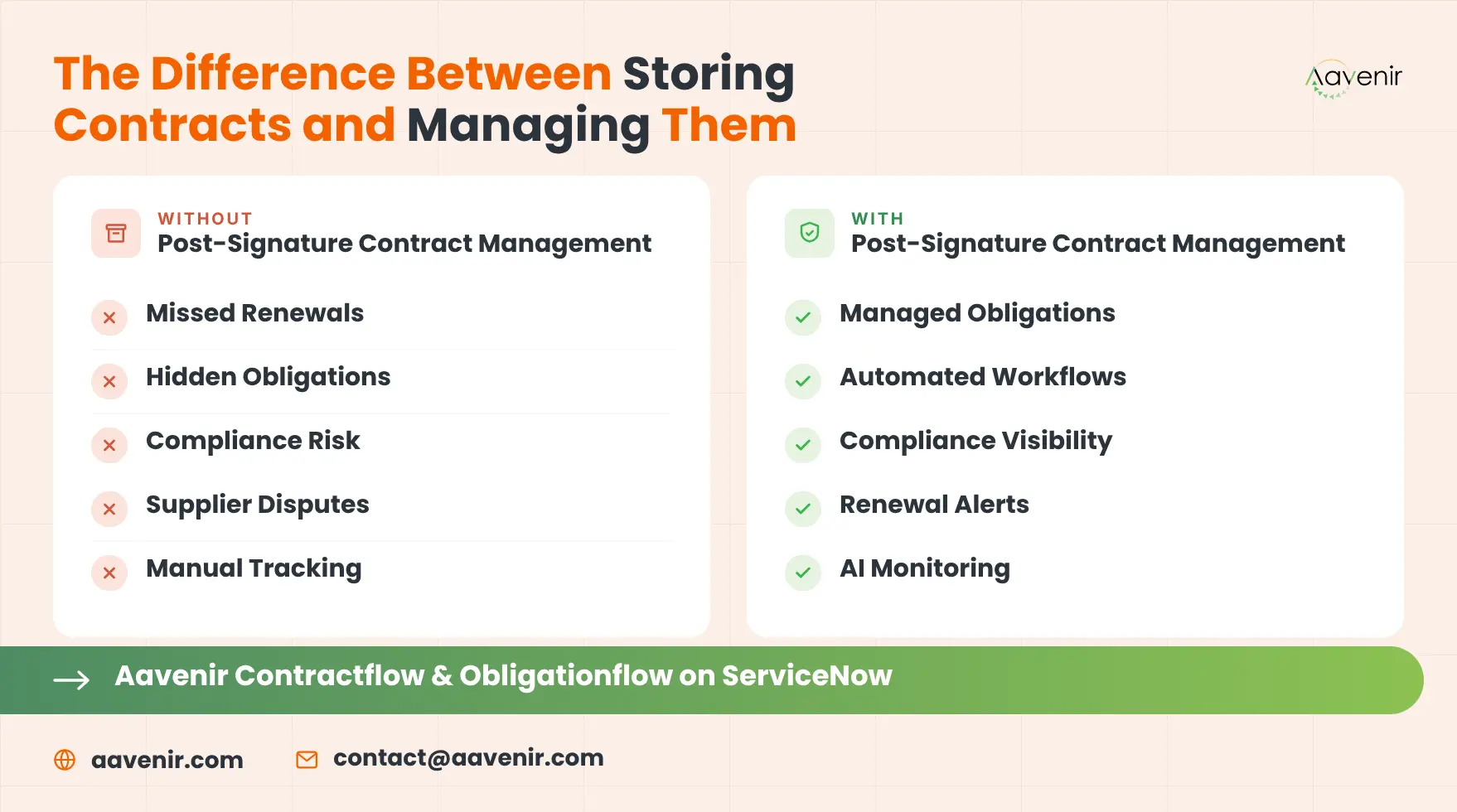
Without a structured approach, organizations often struggle to manage obligations hidden across thousands of contracts, leading to missed renewals, compliance issues, financial leakage, and fragmented accountability.
Modern post-signature contract management solutions help organizations centralize contract execution, improve visibility into contractual commitments, automate governance, and ensure agreements continue to deliver business value long after they are signed.
Why Post-Signature Contract Management Matters
While contract creation often receives the most attention, execution determines whether negotiated value is actually realized.
Research from World Commerce & Contracting (WorldCC) estimates that organizations lose an average of 8.6% of expected contract value due to poor contracting and contract management practices. In more complex industries, value erosion can exceed 15%, highlighting the importance of effective post-signature governance and contract execution. (https://info.worldcc.com/contract-management-aug-2025)
Post-signature management ensures organizations continue to realize the commercial, operational, and compliance benefits negotiated during contracting.
A modern post-signature contract management strategy helps organizations:
- Monitor contractual obligations
- Improve supplier and customer accountability
- Track compliance requirements
- Manage renewals proactively
- Reduce commercial leakage
- Improve contract visibility across business functions
- Strengthen governance and audit readiness
As contract portfolios continue to grow, post-signature governance is becoming a strategic priority for legal, procurement, finance, and compliance leaders.
Why Most Contract Value Sits in Post-Signature Contract Management
Industry research consistently shows that the majority of contractual activity occurs after contracts are signed.
Negotiation establishes commercial intent.
Execution determines whether that intent translates into measurable business outcomes.
During post-signature execution, organizations must coordinate multiple activities across different business functions.
Supplier agreements contain service-level commitments, rebate clauses, pricing protections, reporting requirements, and performance guarantees.
Customer contracts include delivery milestones, payment schedules, renewal conditions, and service commitments.
Procurement agreements define responsibilities that often extend across legal, procurement, finance, operations, compliance, and business stakeholders.
When these commitments are managed manually – or tracked across spreadsheets, emails, and disconnected systems – organizations struggle to maintain visibility and accountability.
This is why post-signature contract management has become one of the fastest-growing areas of investment within modern CLM initiatives.
Commercial Terms Often Go Unused
Many negotiated protections never translate into operational execution.
Organizations frequently overlook:
- Volume discounts
- Rebate clauses
- Pricing protections
- Service credits
- Performance penalties
- Renewal safeguards
Without ongoing monitoring, businesses lose the value they negotiated during contracting.
Accountability Becomes Fragmented
A single enterprise agreement rarely belongs to one department.
Instead, responsibility is distributed across multiple teams.
For example:
- Procurement monitors supplier performance.
- Finance validates commercial commitments.
- Operations manages delivery milestones.
- Legal oversees contractual compliance.
- Business owners prepare for renewals.
Without centralized governance, it becomes difficult to determine who owns each contractual commitment.
Compliance Risk Continues to Increase
Many contractual obligations directly support regulatory and operational compliance.
Examples include:
- Insurance certificate renewals
- ESG reporting
- Data privacy commitments
- Security attestations
- Vendor certifications
- Audit requirements
Missing these obligations can expose organizations to financial penalties, supplier disputes, and regulatory risk.
This is why organizations are expanding their focus beyond contract creation and investing in stronger post-signature governance.
Challenges in Post-Signature Contract Management
Despite significant investments in Contract Lifecycle Management, many organizations still rely on manual processes to manage contracts after execution.
As contract portfolios expand across suppliers, customers, business units, and geographies, maintaining visibility becomes increasingly difficult.
Some of the most common challenges include:
Limited Visibility into Contract Obligations
Critical commitments are often buried within lengthy legal documents, making them difficult to identify and monitor at scale.
Missed Renewals and Expiring Agreements
Without proactive monitoring, organizations risk automatic renewals, unfavorable pricing extensions, and missed renegotiation opportunities.
Fragmented Contract Ownership
Responsibilities are spread across legal, procurement, finance, operations, and compliance teams, creating accountability gaps.
Manual Tracking Processes
Many organizations continue to rely on spreadsheets, emails, and calendar reminders, making consistent execution difficult.
Compliance and Audit Exposure
Organizations must continuously demonstrate compliance with contractual commitments, regulatory obligations, and internal governance policies.
Disconnected Enterprise Systems
Contract information often exists separately from ERP, procurement, supplier management, CRM, and finance platforms, limiting operational visibility.
These challenges have led organizations to rethink post-signature management as a business process rather than simply a contract repository.
Effective Post-Signature Contract Management
Effective post-signature contract management goes beyond storing executed agreements in a repository. It ensures that contractual commitments are translated into operational activities, assigned to the right stakeholders, and continuously monitored throughout the life of the contract.
A mature post-signature strategy connects legal, procurement, finance, compliance, and business teams around a shared view of contractual performance.
The most successful organizations focus on several key capabilities.
Centralized Post-Signature Contract Repository
Executed contracts should be stored in a centralized repository where authorized users can quickly access agreements, search contract content, and retrieve key information.
A centralized repository becomes the single source of truth for contract execution and provides the foundation for effective governance.
Contract Obligation Tracking
Every contract contains commitments that require ongoing action—from service-level agreements and reporting requirements to payment milestones, pricing protections, and renewal notices.
Rather than relying on manual reminders or spreadsheets, organizations should identify, assign, and monitor contractual obligations throughout the contract lifecycle.
Compliance Monitoring
Post-signature management should provide continuous visibility into contractual compliance by tracking fulfillment status, collecting supporting evidence, and maintaining complete audit trails.
This helps organizations reduce regulatory risk while demonstrating adherence to contractual commitments.
Renewal and Amendment Governance
Managing contract renewals proactively helps organizations avoid unintended auto-renewals, preserve negotiation leverage, and ensure commercial terms remain aligned with business objectives.
Similarly, amendments should be tracked alongside the original agreement to maintain a complete view of contractual obligations and commercial commitments.
Workflow Automation
Modern post-signature contract management platforms automate recurring activities such as reminders, approvals, escalations, evidence collection, and notifications, reducing manual effort while improving accountability.
AI Handling Post-Signature Contract Obligations
Managing post-signature obligations manually becomes increasingly difficult as contract portfolios grow.
Organizations often manage thousands of supplier, customer, partner, and procurement agreements – each containing unique language, timelines, conditions, and responsibilities.
Artificial Intelligence is helping organizations overcome this challenge by transforming contracts into structured, actionable data.
Rather than simply storing executed agreements, AI enables organizations to operationalize contractual commitments.
Obligation Identification
Modern AI models analyze executed agreements to identify obligations hidden within highly variable legal language.
Instead of relying on keywords alone, AI understands context to identify:
- Performance obligations
- Reporting requirements
- Payment commitments
- Renewal clauses
- Compliance requirements
- Notice periods
- Service-level agreements
- Audit obligations
This significantly reduces the manual effort required to review contracts at scale.
Intelligent Assignment of Responsibility
Once obligations have been identified, AI can help route them to the appropriate business owner based on predefined rules such as:
- Contract type
- Obligation category
- Department
- Geography
- Supplier
- Business unit
This creates greater accountability while reducing dependency on manual coordination.
Continuous Monitoring
AI can continuously monitor contract portfolios for upcoming deadlines, overdue obligations, expiring agreements, and compliance risks.
Organizations gain proactive visibility into activities requiring attention rather than discovering issues after contractual deadlines have passed.
Improved Search and Contract Intelligence
Instead of searching document by document, teams can ask questions such as:
- Which supplier contracts renew next quarter?
- Which agreements require ESG reporting?
- Which contracts contain cybersecurity obligations?
- Which customer commitments are overdue?
AI search transforms contracts from static legal documents into operational business assets.
Post-Signature Contract Management Software Features
As organizations increasingly recognize the importance of post-signature governance, they are evaluating platforms that support operational execution – not just contract creation.
A modern post-signature contract management solution should include capabilities such as:
Centralized Contract Repository
Store executed agreements securely while making them searchable across business functions.
Contract Intelligence
Automatically identify obligations, dates, risks, milestones, and contractual commitments using artificial intelligence.
Obligation Management
Track contractual commitments, assign ownership, monitor fulfillment, and maintain complete visibility throughout the contract lifecycle.
Renewal Management
Monitor renewal timelines, automate notifications, and reduce the risk of missed notice periods or unintended renewals.
Compliance Tracking
Monitor regulatory commitments, policy requirements, supplier certifications, and contractual obligations while maintaining supporting evidence.
Workflow Automation
Automate reminders, escalations, approvals, and recurring post-signature activities across departments.
Reporting and Dashboards
Provide real-time visibility into obligation status, renewals, compliance metrics, and contract performance through configurable dashboards and reports.
Enterprise Integrations
Connect contract data with ERP, procurement, finance, supplier management, CRM, and workflow platforms to improve operational visibility.
How CLM Platforms Enable Post-Signature Governance
Traditional Contract Lifecycle Management solutions focused primarily on contract creation, negotiation, approvals, and execution.
Modern CLM platforms increasingly extend beyond these pre-signature activities by supporting governance throughout the operational life of the contract.
This shift allows organizations to connect contractual commitments with enterprise processes rather than treating contracts as static documents.
For example:
- Procurement teams can monitor supplier performance against contractual service levels.
- Finance teams can validate pricing commitments and rebate eligibility.
- Compliance teams can track regulatory reporting obligations.
- Operations teams can monitor delivery milestones and fulfillment activities.
- Legal teams can maintain oversight of contractual risk and amendments.
By integrating contract information with enterprise workflows, CLM platforms help organizations improve visibility, accountability, and execution across the entire post-signature lifecycle.
End-to-End Platform for Post-Signature Contract Management
Post-signature management requires more than isolated reminders or obligation tracking tools.
Organizations increasingly need an end-to-end platform that connects executed contracts with the people, processes, and systems responsible for delivering contractual outcomes.
An effective post-signature contract management solution should enable organizations to:
- Maintain a centralized repository of executed contracts
- Extract obligations using AI
- Assign ownership across business functions
- Track fulfillment and compliance
- Manage renewals and amendments
- Automate workflows and notifications
- Integrate with ERP, procurement, finance, and operational systems
- Provide real-time dashboards and audit-ready reporting
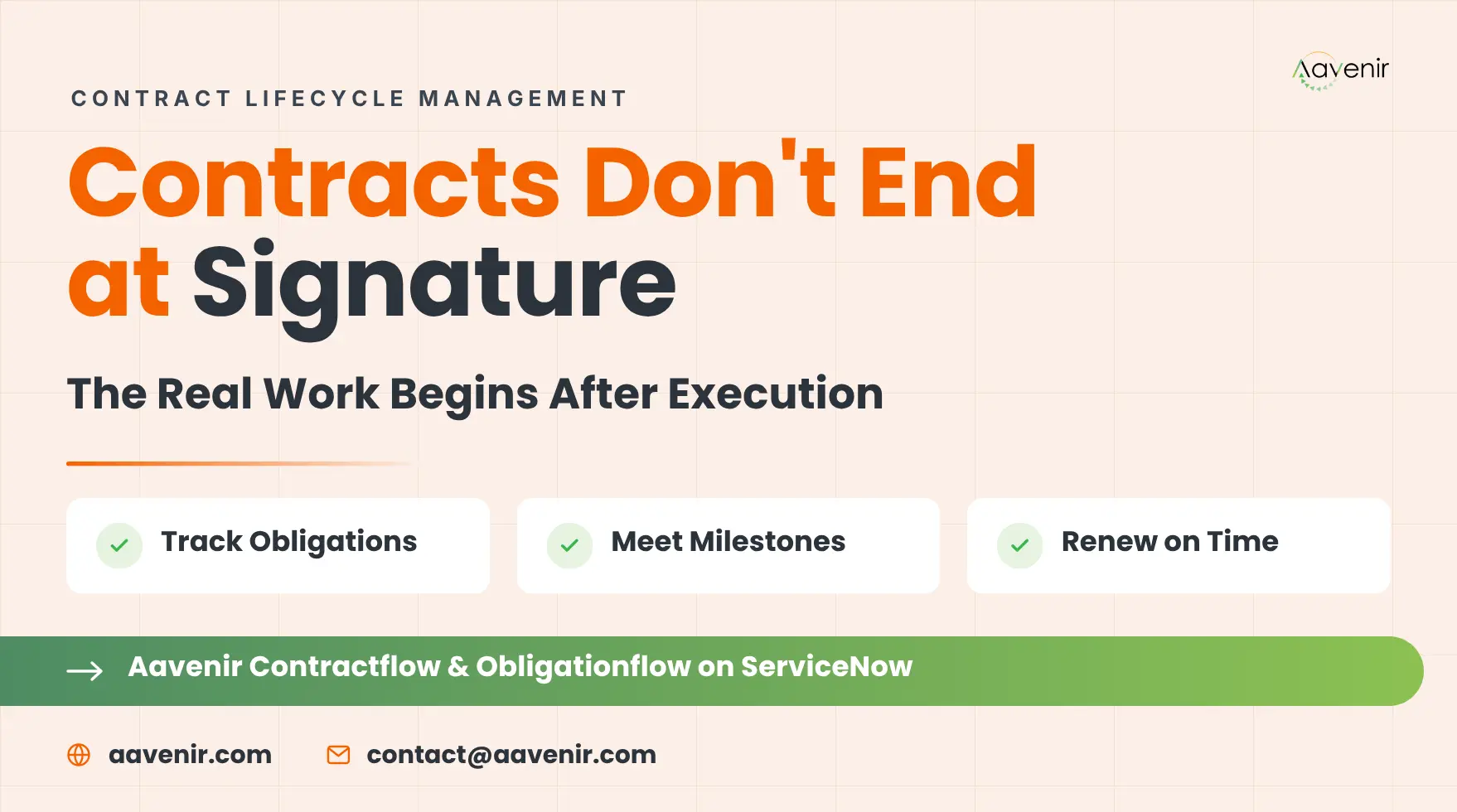
Aavenir Obligationflow, built natively on ServiceNow, helps organizations operationalize post-signature contract management by connecting obligation identification, workflow automation, accountability, and fulfillment monitoring within a unified platform.
Instead of managing post-signature activities across disconnected spreadsheets, emails, and business systems, organizations gain a single operational view of contractual execution, improving governance across legal, procurement, finance, compliance, and operations teams.
Choosing a Post-Signature Contract Management Solution
As organizations evaluate post-signature contract management solutions, the focus has shifted beyond traditional CLM functionality.
Buyers increasingly look for platforms that can operationalize contract execution while supporting enterprise-wide governance.
Key evaluation criteria include:
Contract Intelligence
Can the platform accurately identify obligations, key dates, risks, and commitments across different contract types?
Workflow and Accountability
Does it support automated ownership assignment, reminders, escalations, approvals, and evidence collection?
Enterprise Integration
Can it integrate with ERP, procurement, CRM, finance, supplier management, and workflow platforms to support end-to-end execution?
Scalability
Can it manage thousands of contracts across multiple business units, geographies, and legal entities?
Reporting and Audit Readiness
Does it provide dashboards, compliance reporting, fulfillment history, and complete audit trails?
Selecting a platform that combines AI, workflow automation, and enterprise integration enables organizations to transform contracts from static legal records into operational assets that continuously deliver business value.
Bringing Structure to Post-Signature Contract Management
The next phase of Contract Lifecycle Management is no longer focused solely on drafting, negotiation, approvals, and signatures.
Organizations are increasingly recognizing that contracts only deliver value when they are actively managed after execution. The ability to monitor obligations, govern compliance, manage renewals, and coordinate execution across business functions has become a strategic differentiator.
As contract portfolios grow larger and enterprise ecosystems become more connected, manual approaches to post-signature management become increasingly difficult to sustain. Spreadsheets, email reminders, and disconnected systems simply cannot provide the visibility and accountability required to manage thousands of active agreements.
Modern post-signature contract management solutions address this challenge by combining AI, workflow automation, and enterprise integration to operationalize contractual commitments throughout the life of the agreement.
Organizations that invest in structured post-signature governance are better positioned to:
- Improve contract compliance
- Strengthen supplier and customer accountability
- Reduce commercial leakage
- Improve renewal management
- Increase audit readiness
- Maximize the value negotiated during contracting
Ultimately, successful contract management is measured not by how efficiently contracts are signed, but by how effectively they are executed.
Conclusion
Signing a contract marks the beginning of a business relationship—not the end of the contract lifecycle.
The greatest opportunities to realize value, manage risk, and maintain compliance occur during the post-signature phase, where contractual commitments must be translated into operational execution.
Without structured governance, organizations risk missed obligations, renewal failures, compliance gaps, and fragmented accountability across business functions.
Modern post-signature contract management platforms help organizations move beyond static contract repositories by combining AI-powered contract intelligence, obligation tracking, workflow automation, and enterprise integration. The result is greater visibility into contractual commitments, stronger governance, and improved business outcomes throughout the contract lifecycle.
As organizations continue to modernize procurement, legal, and supplier management processes, post-signature contract management is becoming an essential capability for maximizing contract value and reducing operational risk.
Improve Post-Signature Contract Management with Aavenir
Aavenir Obligationflow, built natively on ServiceNow, helps organizations operationalize post-signature contract management by identifying contractual obligations, assigning ownership, automating workflows, monitoring fulfillment, and improving governance across legal, procurement, finance, compliance, and operations teams.
With AI-powered obligation extraction, configurable workflows, enterprise integrations, and real-time reporting, organizations can transform executed contracts into actionable business processes – improving compliance, accountability, and contract performance long after agreements are signed.
Frequently Asked Questions
What is post-signature contract management?
Post-signature contract management is the process of managing a contract after it has been executed. It includes tracking contractual obligations, monitoring compliance, managing renewals and amendments, overseeing supplier and customer commitments, and ensuring contractual terms are fulfilled throughout the life of the agreement.
Why is post-signature contract management important?
Most contractual value—and risk—emerges after a contract is signed. Effective post-signature contract management helps organizations improve compliance, reduce commercial leakage, manage renewals proactively, strengthen accountability, and ensure contractual commitments are successfully executed.
What role does CLM software play in post-signature management?
Modern Contract Lifecycle Management (CLM) platforms extend beyond contract creation and execution by helping organizations manage obligations, automate workflows, monitor compliance, track renewals, and integrate contract data with procurement, finance, supplier management, and enterprise systems.
How does post-signature management support compliance?
Post-signature management supports compliance by tracking regulatory requirements, monitoring contractual obligations, maintaining audit trails, collecting supporting evidence, and providing visibility into fulfillment status across contracts. This helps organizations demonstrate compliance while reducing legal and operational risk.
How does post-signature management improve renewals and renegotiations?
By monitoring key dates, notice periods, and contract performance throughout the contract lifecycle, post-signature management enables organizations to prepare for renewals proactively, avoid unintended auto-renewals, and negotiate future agreements from a stronger commercial position.
How does AI help manage post-signature contract obligations?
AI uses natural language processing and machine learning to identify obligations, key dates, responsible parties, milestones, and compliance requirements within executed contracts. It can also automate obligation assignment, prioritize upcoming actions, monitor deadlines, and improve searchability across large contract portfolios.
What features should a post-signature contract management solution include?
A modern post-signature contract management solution should provide:
- A centralized post-signature contract repository
- AI-powered obligation extraction
- Contract obligation tracking
- Compliance monitoring
- Renewal and amendment management
- Workflow automation
- Reporting and dashboards
- Enterprise integrations with ERP, procurement, finance, and CRM systems
- Audit trails and governance controls
How is post-signature contract management different from contract storage?
Contract storage focuses on securely storing executed agreements and making them searchable. Post-signature contract management goes much further by helping organizations execute, monitor, and govern contractual commitments through obligation tracking, workflow automation, compliance management, and operational reporting.