
Energy and Utilities companies operate in one of the most regulated, asset-intensive, and operationally complex sectors in the world. Compliance obligations are buried across power purchase agreements, interconnection contracts, vendor SLAs, environmental permits, pricing clauses, maintenance schedules, and safety mandates. When these obligations are not centralized and tracked, compliance failures multiply.
The Problem:
Fragmented contract storage, siloed teams, high regulatory pressure, manual spreadsheets, and obligations hidden across multi-year agreements.
The Impact:
Revenue leakage, regulatory penalties, SLA failures, safety incidents, environmental non-compliance, and prolonged audits.
The Solution:
Centralized contract visibility, AI-driven obligation extraction, automated workflows, continuous monitoring, and organization-wide accountability are powered by platforms such as Aavenir ComplianceNext.
Energy and Utilities Need a More Reliable Way to Manage Compliance
Manual tracking cannot scale with multiple obligations. Aavenir ComplianceNext centralizes obligations, assigns ownership, automates monitoring, and delivers real-time compliance visibility.
The Compliance Reality in Energy and Utilities
Contract compliance in the Energy and Utilities sector is among the most difficult to manage because the entire industry runs on long-term, high-stakes agreements. Power purchase agreements, renewable energy contracts, grid interconnection deals, vendor and OEM maintenance contracts, field service agreements, emissions and environmental permits, and safety mandates all contain obligations that must be executed precisely.
These contractual requirements span engineering, safety, legal, procurement, environmental, regulatory, risk management, finance, and field operations. When obligations are scattered across systems and never fully operationalized, compliance breaks down. The issue is not a lack of effort. The problem is the complexity of contracts and the lack of a unified execution process.
Why Contract Compliance Fails in the Energy and Utilities Sector
Contract compliance fails because teams operate in silos, information is fragmented, and obligations are never converted into structured, trackable actions.
A. Decentralized Contract Storage
Contracts sit in email chains, shared drives, legacy systems, or individual desktops. Field teams never see legal clauses. Legal teams never see operational deviations. This creates outdated commitments, missed deadlines, and blind spots.
B. Operational Complexity
Energy operations involve multi-year, multi-party contracts where obligations influence generation, transmission, safety, maintenance, and customer service. Without automated handoffs and reminders, gaps are guaranteed.
C. Regulatory Overload
Agencies such as the Environmental Protection Agency, the Federal Energy Regulatory Commission, and the Pipeline and Hazardous Materials Safety Administration frequently update their mandates. Europe faces evolving rules from the European Commission, the Fit for 55 package, and renewable energy regulations. Contracts rarely keep pace with regulation.
D. Siloed Workflows Across Legal, Engineering, Safety, and Operations
Teams execute their portions of obligations independently. No central system ensures commitments have owners, timelines, or monitoring.
E. Manual Tracking Leads to Blind Spots
Spreadsheets cannot manage 3000-plus obligations related to emissions, inspections, grid reliability, vendor uptime, and maintenance cycles. Manual tracking guarantees non-compliance.
The Most Common Contract Compliance Gaps in North America
North American utilities struggle most with environmental reporting, vendor performance, maintenance obligations, and pricing adjustments.
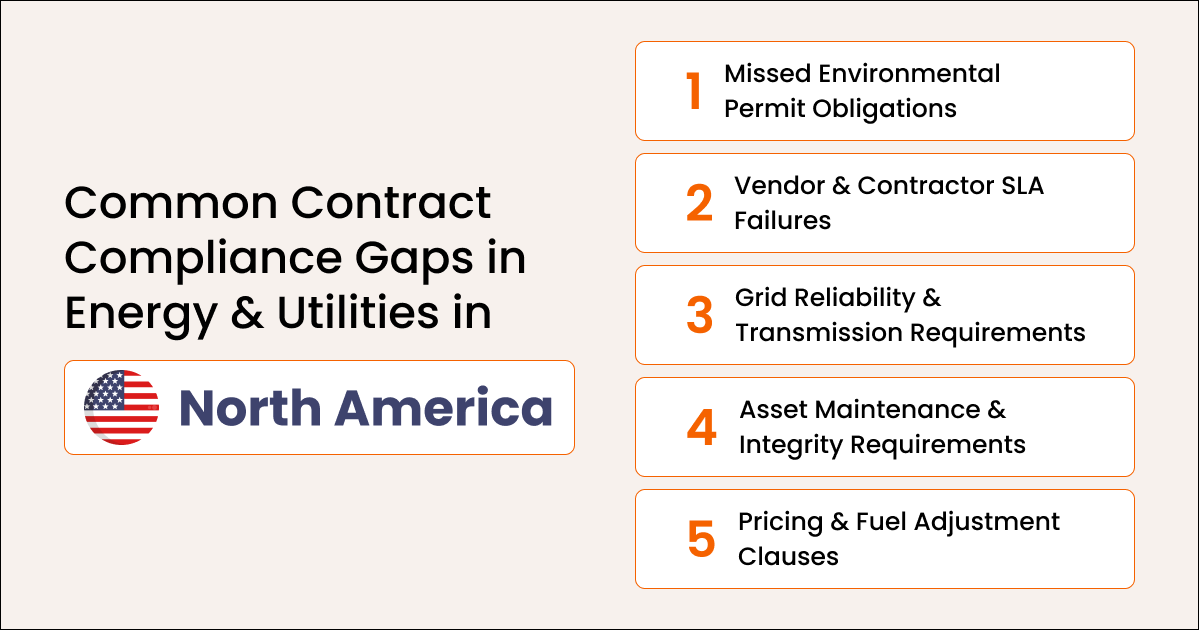
Missed Environmental Permit Obligations (EPA, FERC, PHMSA)
Reporting deadlines, emissions thresholds, spill notifications, and leak detection survey obligations are often missed due to manual tracking across departments.
Vendor and Contractor SLA Failures
OEM maintenance commitments, turbine servicing cycles, transformer inspections, and outage response times frequently slip through execution gaps.
Grid Reliability and Transmission Requirements
Interconnection and transmission agreements contain complex reliability obligations. Multi-team handoffs cause missed steps.
Asset Maintenance and Integrity Requirements
Pipeline integrity checks, generation asset inspections, and preventive maintenance schedules are buried in OEM and service contracts, making them easy to overlook.
Pricing and Fuel Adjustment Clauses
Incorrect application of fuel adjustments or energy cost changes leads to billing discrepancies and revenue leakage.
The Most Common Contract Compliance Gaps in Europe
Europe faces stricter environmental and data governance requirements, resulting in more document-intensive compliance expectations.
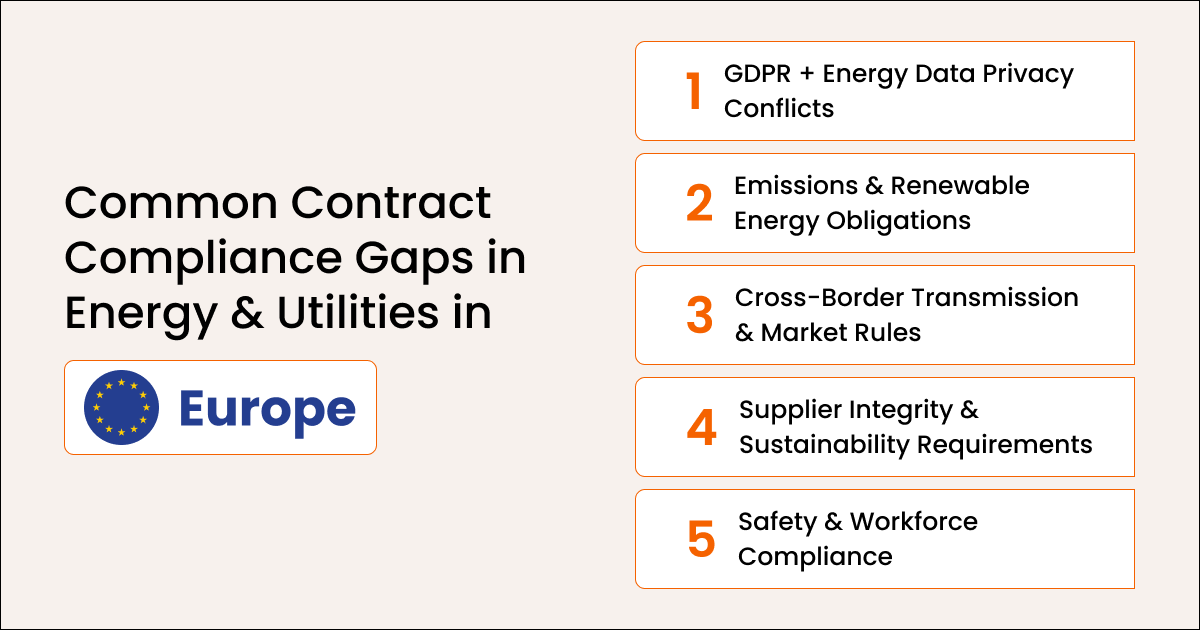
GDPR plus Energy Data Privacy Conflicts
Cross-vendor data exchange often violates the strict rules of the General Data Protection Regulation when not appropriately monitored.
Emissions and Renewable Energy Obligations (EU ETS, Fit for 55)
Compliance with EU ETS requires precise reporting, crediting, and documentation. Manual processes fall short.
Cross-Border Transmission Rules
Energy supply, trading, and transmission obligations differ across borders, making alignment difficult.
Supplier Integrity and Sustainability Requirements
ESG, sourcing, and fair-trade mandates often go unchecked due to a lack of structured compliance monitoring.
Safety and Workforce Compliance
Workforce licensing, safety certifications, and periodic inspection cycles frequently get missed.
Why These Gaps Matter: The Impact of Non-Compliance
Compliance failures carry severe operational, financial, environmental, and regulatory consequences that escalate quickly.
Regulatory Penalties
Environmental breaches, emissions violations, grid reliability failures, and safety lapses result in substantial fines and increased regulatory oversight.
Revenue Leakage and Billing Disputes
SLA failures, incorrect adjustments, and vendor underperformance reduce revenue, inflate costs, and spark customer disputes.
Operational Disruptions
Missed maintenance obligations lead to equipment failures, costly downtime, and safety incidents.
Customer and Community Impact
Outages, rate errors, and environmental incidents damage public trust and provoke community backlash.
Audit Failure and Oversight Issues
Missing documentation, inconsistent evidence, and unverified obligations lead to extended audits and forced remediation cycles.
How to Detect Contract Compliance Gaps in Energy and Utilities
You cannot fix what you cannot see. Detection begins with centralizing information, automatically extracting obligations, and connecting contract requirements to the operational systems that execute them. Energy and Utilities companies must shift from reactive audits to continuous, real-time visibility.
Centralized Contract Repository
A unified repository eliminates the fragmentation caused by shared drives, email threads, and legacy storage systems. When every contract and amendment lives in one place, teams gain immediate access to the most current obligations. This foundational step prevents missed commitments caused by version confusion or document sprawl.
AI-Powered Obligation Extraction
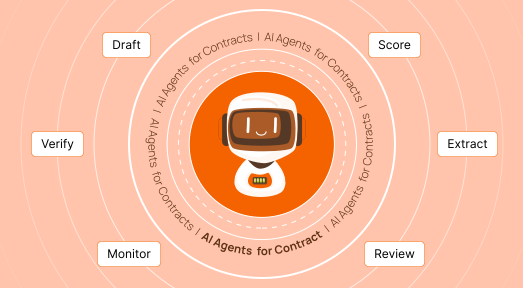
AI ensures no obligation is overlooked by scanning complex power purchase agreements, maintenance contracts, environmental permits, and vendor SLAs. It extracts every operational, safety, environmental, and financial requirement hidden across hundreds of pages. This creates a structured obligation library that humans can monitor and act upon at scale.
Mapping Obligations to Teams and Systems
Obligations do not matter until they are assigned and executed. Mapping each obligation to the right team, system, or operational workflow ensures legal language becomes actionable tasks. This reduces handoff gaps, clarifies ownership, and closes the loop between contract intent and field execution.
SLA and Performance Detection Through Data Integration
Integrating CMMS, EAM, SCADA, outage management systems, and vendor performance data reveals real-time compliance gaps. This allows organizations to detect SLA breaches, missed maintenance cycles, delayed inspections, and underperforming contractors long before they escalate into fines or downtime.
Compliance Heatmaps and Exception Reports
Heatmaps provide an instant visual of where the highest risks reside across operations, assets, vendors, and environmental domains. Exception reports highlight overdue tasks, upcoming deadlines, and critical deviations. This real-time intelligence empowers operational executives and compliance teams to intervene before issues become violations.
Are Your Contract Obligations Too Complex to Track Manually?
Aavenir Obligationflow extracts, structures, assigns, and tracks every operational, safety, and environmental requirement hidden inside your contracts. See Obligationflow in Action
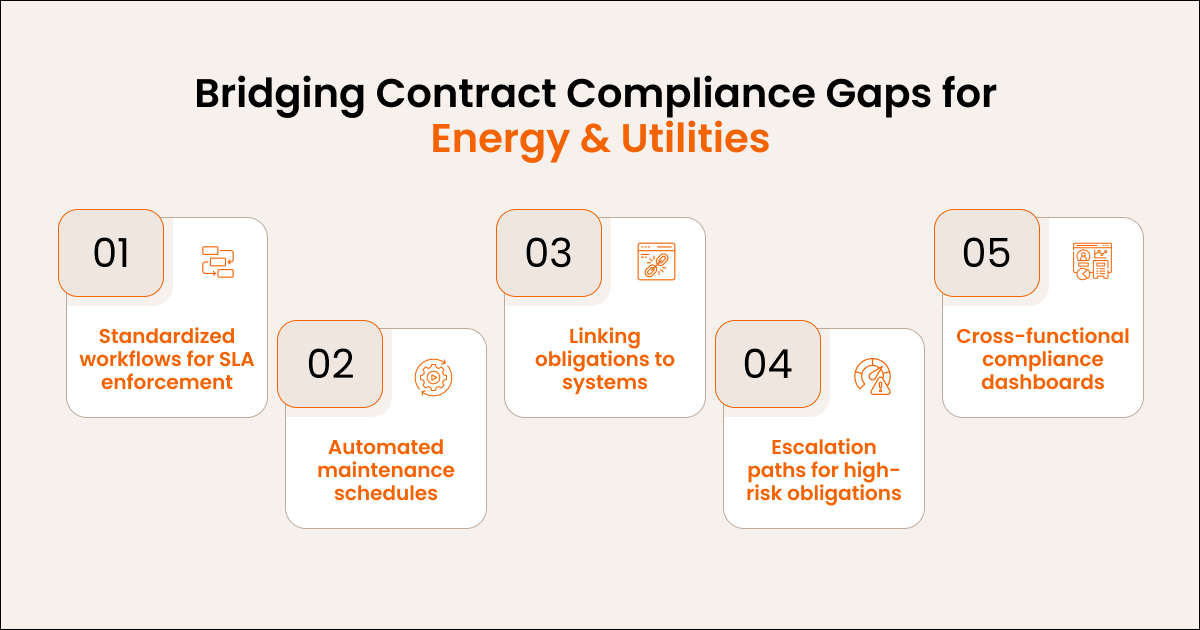
How to Bridge Contract Compliance Gaps
Bridging gaps requires converting obligations into structured, trackable workflows.
- Assigning ownership and accountability
- Linking obligations to operational systems such as CMMS, EAM, and SCADA
- Automating inspection cycles and maintenance tasks
- Enforcing SLA management workflows
- Creating cross-functional compliance dashboards
- Enabling timely escalations for high-risk obligations
How to Continuously Monitor Contract Compliance
Continuous monitoring ensures accountability and provides early warnings before non-compliance escalates.
- Real-time dashboards for obligations and performance
- Automated alerts for deadlines, deviations, and SLA breaches
- Evidence logs for audits
- Vendor performance tracking
- Environmental monitoring integrated with emissions data
- Exception reporting for leadership
The Operational Answer: How Aavenir ComplianceNext Solves the Problem
ComplianceNext brings structure, automation, and visibility across thousands of contractual and regulatory obligations.
Aavenir ComplianceNext centralizes contracts, extracts obligations using AI, assigns ownership, monitors performance, generates alerts, captures evidence, and ensures every requirement is met on time. It transforms compliance from reactive to proactive and gives leaders real-time clarity across legal, environmental, operational, and safety workflows.
Conclusion
Energy and Utilities companies operate with high stakes and even higher complexity. Manual compliance models cannot sustain environmental demands, operational risks, and regulatory oversight. The only path forward is automation, structured obligation management, and continuous monitoring.
Organizations in North America and Europe face different regulatory pressures but share one common issue. Compliance breaks when obligations are not visible, structured, or monitored. With AI-driven detection, automated workflows, and enterprise-wide tracking, Energy and Utilities leaders can create a compliance model built for the future.
Aavenir ComplianceNext ensures that every commitment made in a contract is fulfilled without fail. It gives leaders the confidence to operate with integrity, precision, and resilience.
Is your team struggling to monitor thousands of contractual and regulatory obligations?
Discover how Energy and Utilities companies are gaining real-time visibility across their compliance landscape.
FAQs
1. What causes contract compliance gaps in the Energy and Utilities sector?
Compliance gaps typically arise due to fragmented contract storage, siloed teams, manual tracking methods, and complex multi-year agreements covering generation, transmission, maintenance, and environmental obligations. When information is scattered and obligations are not operationalized properly, critical requirements are missed.
2. Which regulatory bodies influence compliance obligations for Energy and Utilities companies?
Agencies such as the Environmental Protection Agency, the Federal Energy Regulatory Commission, and the European Commission impose evolving rules on emissions, safety, grid reliability, and data governance. Failure to align contracts and processes with these shifting regulations often triggers non-compliance.
3. What are the most significant risks of missing contract obligations in this industry?
Non-compliance can lead to penalties, safety incidents, service interruptions, revenue leakage, vendor disputes, emissions violations, and prolonged audits. In severe cases, breaches may halt operations or invite additional regulatory oversight.
4. Can AI help improve contract compliance accuracy?
Yes. AI can scan complex Energy and Utilities contracts, extract obligations, classify them, and map them to operational workflows or systems. It identifies missed deadlines, SLA breaches, maintenance lapses, and environmental deviations by comparing contract terms with real-time data, reducing manual effort and increasing accuracy.
5. How can Energy and Utilities organizations start improving their compliance framework?
Begin by centralizing contracts and digitizing obligations. Then assign ownership, integrate contract terms with operational systems, and automate monitoring. Continuous alerts, SLA tracking, regulatory mapping, and structured workflows help eliminate blind spots and reduce risk.