
Energy and Utilities companies operate in one of the most regulated, performance-driven environments. Every contract contains commitments around performance, safety, environmental controls, emissions, cybersecurity, customer service levels, vendor responsibilities, and asset management. These obligations impact day-to-day operations, regulatory standing, and financial performance.
Why Organizations Struggle
Most obligations are stored as text inside lengthy contracts, schedules, annexures, amendments, and regulatory documents. Without a structured system, organizations rely on scattered spreadsheets, email reminders, or tribal knowledge. As a result, obligations get missed, delayed, or misinterpreted. This creates a systematic risk that affects multiple teams and business processes.
What Obligation Management Challenges Do Stakeholders Face
Legal and Contract Teams: Difficulty Translating Language into Action
Legal teams can identify obligations but struggle to operationalize them. Contract language is complex, scattered across documents, and often updated through change orders. Turning this into actionable tasks for operations or procurement is time-consuming and inconsistent.
Operations and Field Teams: Unclear Ownership and Missing Evidence
Execution teams are responsible for delivering obligations such as inspections, maintenance tasks, safety checks, or reporting. Yet they often don’t know which obligations are linked to their work or when they are due. Even when work is done, evidence is frequently missing, incomplete, or not stored in a centralized system.
Procurement and Vendor Management: Hard to Track Supplier Commitments
Vendors play a crucial role in utility operations. Supplier performance obligations, penalties, service visits, and compliance attestations often go unmonitored. When obligations are not enforced, utilities face increased downtime, higher risk, and unexpected costs.
Finance Teams: Revenue Leakage and Missed Commercial Opportunities
Financial obligations, such as rebates, penalties, milestone payments, or rate adjustments, are easily overlooked. Poor visibility results in revenue leakage, missed entitlements, and incorrect billing. Auto-renewals and pricing changes also slip through without centralized tracking.
Risk, Compliance, and Audit: Inconsistent Visibility and Slow Audit Response
Regulators expect utilities to maintain strong oversight of their obligations. However, when obligations are tracked manually, organizations struggle to retrieve evidence, respond to audits quickly, or maintain compliance across multiple plants and jurisdictions. This increases risk exposure and operational stress.
Looking to Strengthen Compliance and Audit Readiness?
Aavenir ComplianceNext helps Energy and Utilities organizations automate compliance tracking, centralize evidence, and stay audit-ready across regions and regulatory frameworks. Learn how ComplianceNext can support your compliance program.
Obligation Management Challenges in North America
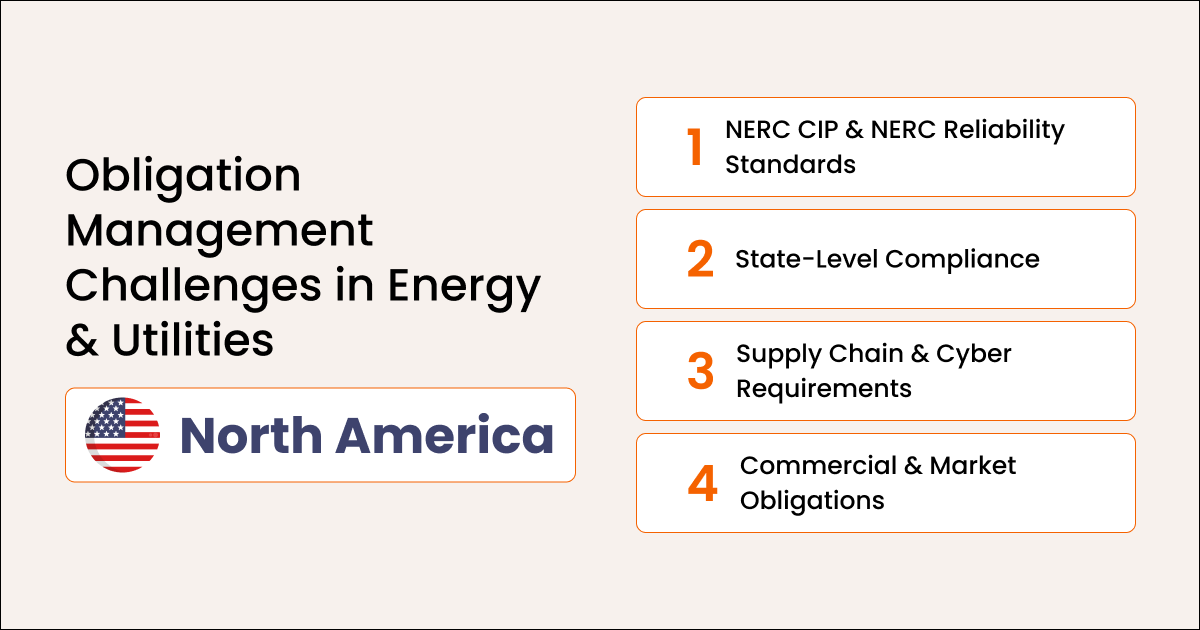
Regulatory Expectations Under NERC Reliability and CIP Standards
North American utilities face strict requirements under NERC standards. These include evidence-heavy obligations for access control, maintenance cycles, system patching, incident management, cybersecurity, and physical security. Tracking these obligations manually makes consistent compliance nearly impossible.
State-Level Reporting and Regional Variability
Each state or region may have different reporting requirements, outage communication protocols, or emissions obligations. When utilities operate across multiple states, obligation management becomes fragmented, with no unified process for synchronization.
Supply Chain and Cybersecurity Mandates
North American regulatory bodies emphasize supply chain security. Vendors must follow specific cybersecurity processes, provide attestations, and maintain compliance with approved standards. Keeping track of all vendor-related obligations is challenging without automation.
Market-Driven Performance Requirements
Demand response programs, capacity obligations, and outage notifications carry strict timelines. Missing these obligations can lead to penalties, lost revenue, or customer dissatisfaction. Manual tracking is not efficient enough for these time-sensitive commitments.
Obligation Management Challenges in Europe
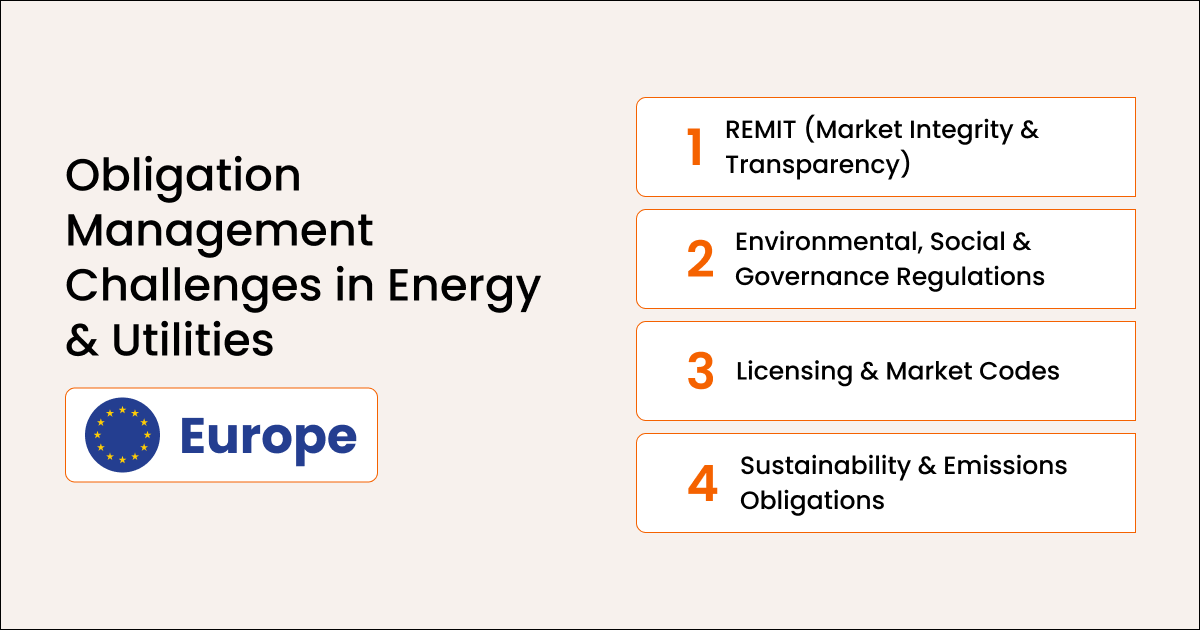
REMIT Market Integrity and Transparency Obligations
European companies must meet REMIT requirements, which include publishing inside information and reporting transaction data. These obligations are event-driven and time-sensitive, requiring immediate action and complete accuracy. Manual workflows cannot keep pace with these expectations.
Environmental and Sustainability Reporting (CSRD, ESRS, ETS)
CSRD and other sustainability mandates require detailed tracking of environmental obligations, emissions data, and value-chain commitments. Utilities must correlate contract obligations with operational data, which is difficult without standardized templates and automation.
Licensing and Market Code Compliance
European utilities must follow operational rules outlined in market codes and licensing frameworks. These obligations may change frequently, and companies must update their internal procedures accordingly. A static system cannot support these evolving requirements.
Cross-Border Coordination
Utilities operating across multiple EU countries face differing regulatory environments. Aligning obligations across regions becomes complicated, especially when audits require harmonized reporting and evidence management.
The Impact of Poor Obligation Management
Operational Disruptions
Missed maintenance cycles, safety inspections, or incident reporting obligations increase operational risk. Poor tracking creates gaps that can lead to outages, equipment damage, or safety failures.
Financial Loss and Margin Erosion
Revenue leakage occurs when penalties, credits, rebates, and performance-based payments go untracked. Without systematic visibility, organizations lose opportunities and face unexpected costs, reducing long-term profitability.
Regulatory and Audit Exposure
Late or incomplete reporting, missing evidence, and inconsistent compliance processes invite scrutiny from regulators. The cost of remediation programs and penalties often exceeds the investment required to manage obligations properly.
Vendor Performance Challenges
If supplier obligations aren’t enforced, utilities face delays, service disruptions, and increased risk. Poor visibility into vendor performance affects overall system reliability.
Internal Inefficiencies
Teams spend hours searching for documents, chasing task owners, or preparing audit packages manually. This slows down operations, increases workload, and reduces productivity across departments.
How to Overcome Obligation Management Challenges: The Role of AI
AI-Powered Extraction for Faster Obligation Identification
AI can automatically extract obligations from contracts, PPAs, annexures, and amendments. Instead of manually reading hundreds of pages, teams receive structured lists of obligations with clear metadata.
Automated Assignment and Workflow Routing
Once obligations are identified, AI routes them to the appropriate teams with due dates, dependencies, and reminders. This minimizes human oversight errors and ensures accountability.
Real-Time Evidence Capture and Audit Trails
AI-enabled systems allow teams to attach reports, photos, documents, and approvals directly to each obligation. Evidence is timestamped, centralized, and ready when audits occur.
Predictive Insights to Prevent Non-Compliance
AI can identify obligations at risk of delay based on historical patterns, workload, vendor performance, or dependency issues. This allows teams to address issues before they escalate.
Cross-Regional Harmonization
AI helps standardize obligations across regions, ensuring that US, UK, and EU obligations follow a common format and comply with respective frameworks. This enhances consistency and reduces complexity.
How Aavenir’s Obligation Management Solution Helps
Managing obligations manually or through scattered tools creates gaps that directly affect compliance, vendor performance, system reliability, and financial outcomes. Aavenir’s obligation management solution brings structure, automation, and intelligence to the entire lifecycle of obligation execution. It enables Energy and Utilities organizations to consolidate obligations from all contracts, track execution across teams, ensure audit readiness, and maintain visibility across regions.
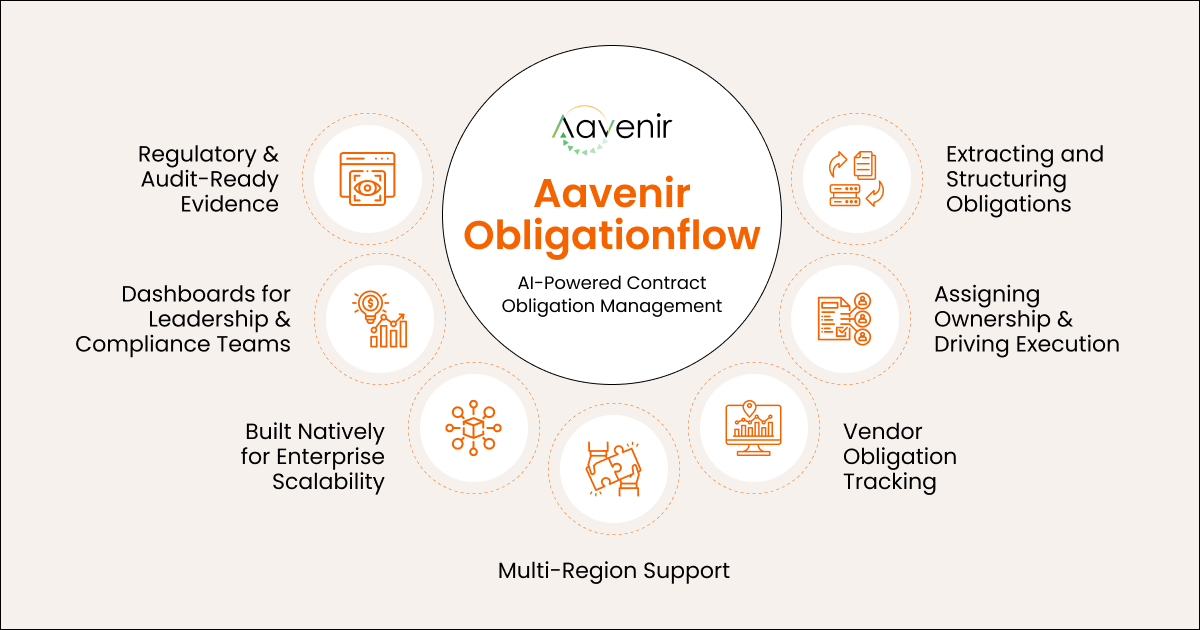
Below are the key capabilities that make Aavenir uniquely effective for this industry.
AI-Driven Extraction and Structuring
Aavenir automatically extracts obligations from contracts, annexures, PPAs, and amendments, converting them into structured, categorized items. This ensures obligations are visible, standardized, and ready for operational execution.
Automated Task Assignment and Execution Management
The platform ensures every obligation is assigned to the right stakeholder with due dates, reminders, dependencies, and escalations. This removes ambiguity and ensures accountability across legal, operations, procurement, compliance, and vendor teams.
Vendor Obligation Tracking
Aavenir centralizes all supplier-related commitments, SLAs, penalties, and deliverables. Procurement teams gain a complete view of vendor performance, making it easier to enforce compliance and reduce third-party risk.
Audit-Ready Evidence and Compliance Reporting
The system stores documentation, inspection reports, approvals, certifications, and communication directly against each obligation. Evidence is timestamped and easily retrievable, reducing the stress and effort of audits.
Dashboards and Leadership Visibility
Aavenir provides real-time dashboards that highlight at-risk obligations, overdue items, vendor performance issues, and regional compliance gaps. Leaders can identify trends quickly and take corrective action before issues escalate.
Support for Multi-Region, Multi-Regulation Environments
The platform is designed to support complex regulatory environments such as NERC in North America, REMIT and licensing codes in Europe, and sustainability frameworks like CSRD. This makes Aavenir ideal for utility companies operating across diverse jurisdictions.
Want to Explore the Full Capability Framework?
Download the Aavenir Obligationflow Datasheet to discover detailed features, workflows, integrations, and real-world use cases designed specifically for Energy and Utilities organizations.
Conclusion
Obligation management is no longer a back-office task. In Energy and Utilities, it influences operational reliability, revenue assurance, regulatory compliance, and vendor performance. Yet many companies still rely on manual processes that cannot scale with industry complexity.
By applying AI and centralized automation, organizations can transform obligations into clear, trackable, and auditable components of their operations. Aavenir’s obligation management solution brings structure, automation, and visibility, enabling Energy and Utilities companies to stay compliant, reduce risk, and protect revenue.
With better obligation management, companies move from reactive firefighting to proactive governance, achieving stronger operational integrity and regulatory confidence.
Ready to See It in Action?
If you’d like to understand how Aavenir can help you streamline obligation execution, improve compliance, and protect revenue across your Energy and Utilities operations, book a personalized demo with our team today.