
Healthcare organizations operate in one of the most regulated and high-risk environments globally. Whether hospitals, clinics, health systems, insurers, diagnostic networks, or pharmaceutical providers, all face obligations tied to patient care, vendor relationships, reimbursement rules, payer contracts, service-level agreements, cybersecurity requirements, regulatory mandates, and accreditation standards.
Why Healthcare Struggles
Obligations are buried inside payer contracts, provider agreements, vendor MSAs, clinical service contracts, quality-of-care standards, HIPAA policies, safety protocols, and accreditation requirements. When these obligations aren’t centralized or trackable, healthcare organizations face performance gaps, audit failures, compliance violations, and financial penalties. Manual tracking cannot scale.
What Obligation Management Challenges Do Stakeholders Face in Healthcare?
Legal and Contract Teams: Complex, High-Volume Agreements
Healthcare legal teams manage thousands of payer contracts, provider employment agreements, telehealth agreements, IT service contracts, device leases, drug supply agreements, and compliance documents. Turning dense contractual language into operational obligations is slow and error-prone. Small oversights lead directly to clinical, financial, or regulatory consequences.
Clinical Operations: Patient Safety Requirements and Service SLAs
Clinicians and operational leaders must comply with obligations related to patient safety, quality metrics, staffing ratios, medical device checks, infection control measures, and emergency response requirements. When obligations are unclear or poorly communicated, patient outcomes and accreditation status are at risk.
Supply Chain & Vendor Management: SLA and Compliance Oversight
Healthcare relies heavily on vendors for pharmaceuticals, devices, equipment servicing, IT infrastructure, and outsourcing. Without structured obligation tracking, organizations struggle to enforce SLAs, verify compliance, and monitor vendor performance across areas such as sterilization, maintenance, cybersecurity, and timely delivery.
Finance & Revenue Cycle: Contractual Reimbursement Obligations
Payer-provider contracts contain obligations around documentation quality, coding accuracy, prior authorization, claims submission timelines, appeals processes, and reimbursement eligibility. Missing any single obligation leads to claim denials, delayed payments, or revenue leakage.
Risk, Compliance, and Audit: The Burden of Evidence & Reporting
Healthcare compliance teams navigate HIPAA, CMS, OIG, Joint Commission, HHS, FDA, OSHA, and state-level regulatory frameworks. Each framework requires evidence, reporting, controls, and audit readiness. Manual spreadsheets cannot support multi-site, multi-state compliance responsibilities.
Looking to Strengthen Compliance and Audit Readiness?
Aavenir ComplianceNext centralizes evidence, automates compliance workflows, and provides audit-ready visibility across all regulatory frameworks, including HIPAA, CMS, OSHA, accreditation requirements, and payer mandates.
Obligation Management Challenges in Healthcare Across North America
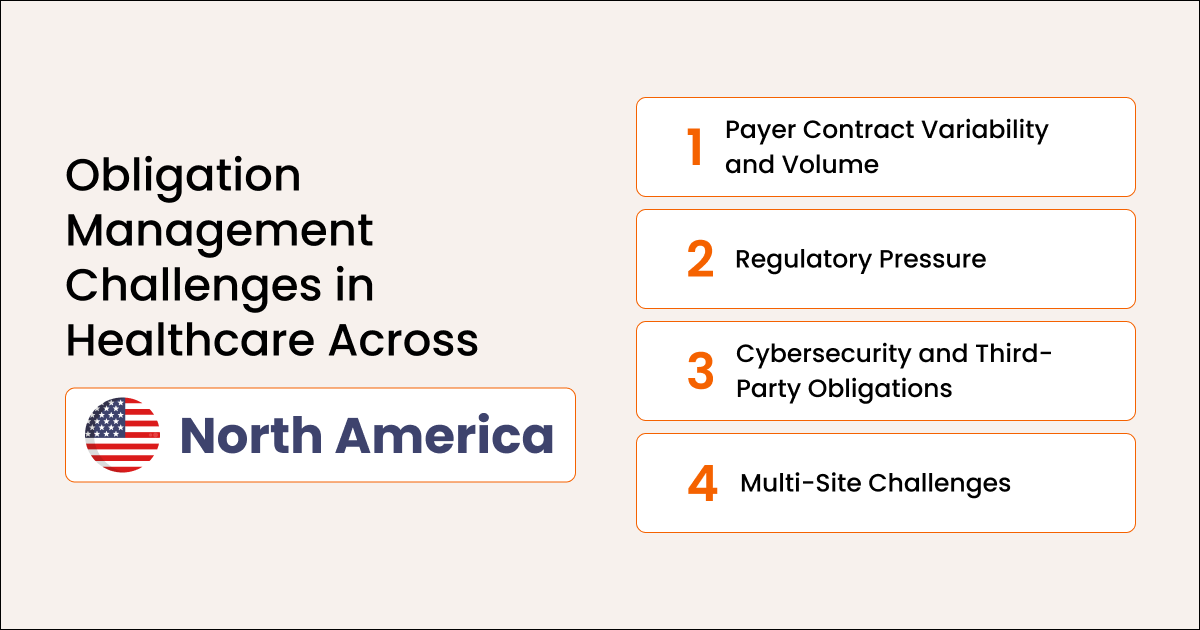
Payer Contract Complexity
US healthcare contracts include dense clauses around reimbursement rates, billing timelines, data sharing, quality measures, readmission rates, and appeals. Obligations vary across Medicare, Medicaid, commercial payers, and value-based care contracts. Managing these manually leads to widespread revenue leakage.
Regulatory Pressure: HIPAA, CMS, Joint Commission
Healthcare organizations must meet obligations tied to privacy, security, clinical quality, facility safety, infection control, and documentation. Missing a single obligation can trigger penalties or jeopardize accreditation.
Cybersecurity and Third-Party Risk Requirements
With increasing cyberattacks, obligations around vendor cybersecurity posture, system access, encryption, logging, and breach notification are rising. Manual tracking puts organizations at serious risk.
Multi-Site, Multi-State Operations
Large health systems operate across multiple states with differing licensing requirements, care standards, and regulatory expectations. Obligation consistency becomes difficult without automation.
Obligation Management Challenges in Healthcare Across Europe
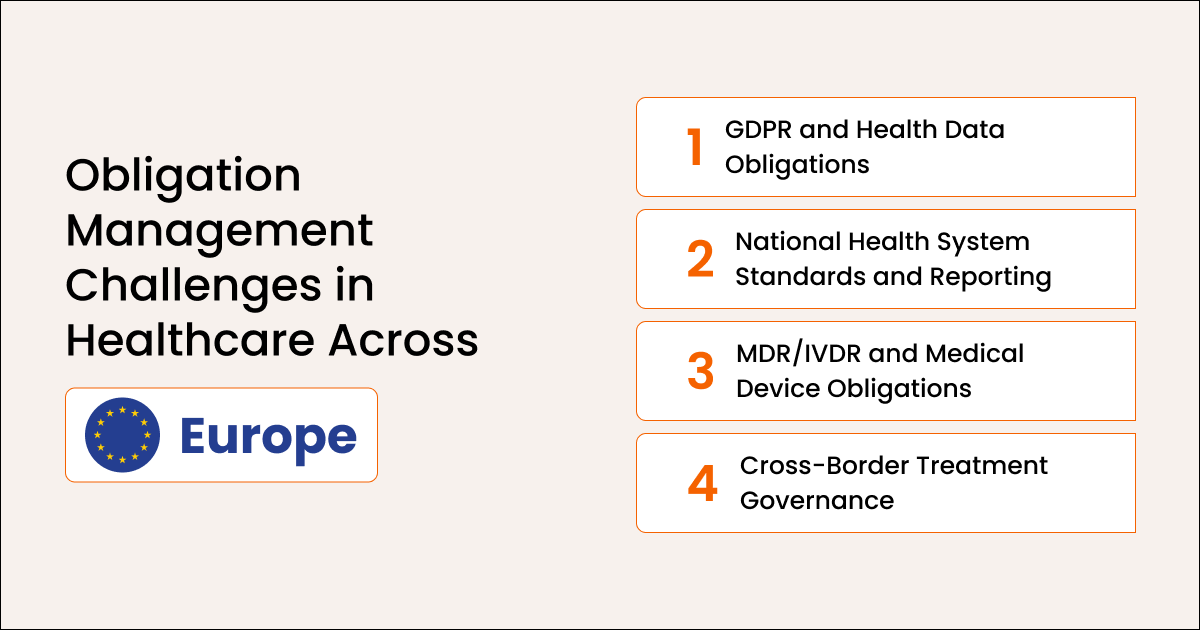
GDPR and Patient Data Protection
European healthcare institutions must comply with GDPR and local health data protection laws. Obligations around consent, data handling, data minimization, access controls, and breach notification timelines require strict operational alignment.
National Health System Requirements
Countries like the UK, Germany, France, and the Nordics have health system-specific guidelines, performance obligations, and reporting standards. Healthcare providers must align obligations across diverse frameworks.
Device and Pharmaceutical Compliance
Manufacturers and providers must meet obligations set by the EU MDR/IVDR regulations for medical devices and pharmaceuticals. These obligations affect quality processes, reporting, traceability, and vendor oversight.
Cross-Border Healthcare Agreements
EU healthcare systems often collaborate across borders for specialized treatments. Obligations for reimbursement, documentation, and compliance differ by region and require centralized tracking.
The Impact of Poor Obligation Management in Healthcare
Patient Safety Risks
Missed clinical obligations, delayed device maintenance, or non-compliant procedures directly impact patient outcomes and safety.
Revenue Loss and Denials
Missed payer documentation requirements, coding errors, appeal deadlines, or reimbursement obligations lead to denials, underpayments, and significant revenue leakage.
Regulatory Violations and Accreditation Risk
Lack of evidence or noncompliance with obligations can trigger penalties, audits, or loss of accreditation from bodies such as the Joint Commission or national ministries of health.
Vendor Performance Gaps
Poorly enforced vendor obligations lead to supply chain disruption, delayed medical device servicing, or cybersecurity incidents.
Operational Inefficiencies
Staff spend hours chasing documents, tracking obligations manually, or responding to audit findings. This increases cost and workload while reducing care quality.
How to Overcome Healthcare Obligation Management Challenges: The Role of AI
AI-Powered Contract Obligation Extraction
AI identifies obligations across payer contracts, service agreements, SLAs, staffing contracts, safety policies, and compliance documents. This removes the burden of manual review.
Automated Workflows and Ownership Assignment
AI routes obligations to clinical, financial, compliance, or operational teams based on their respective responsibilities and due dates. Automated reminders ensure accountability.
Real-Time Evidence Collection
AI systems centralize documents, clinical logs, vendor attestations, audit evidence, and certifications linked to specific obligations.
Predictive Compliance Risk Alerts
AI predicts which obligations may be missed based on trends, staffing constraints, or vendor delays. Teams can intervene proactively.
Cross-Region, Multi-Regulation Standardization
AI harmonizes obligations across HIPAA, GDPR, CMS, Joint Commission standards, and insurance payer frameworks. This creates consistency across the entire organization.
How Aavenir’s Obligation Management Solution Helps Healthcare Organizations
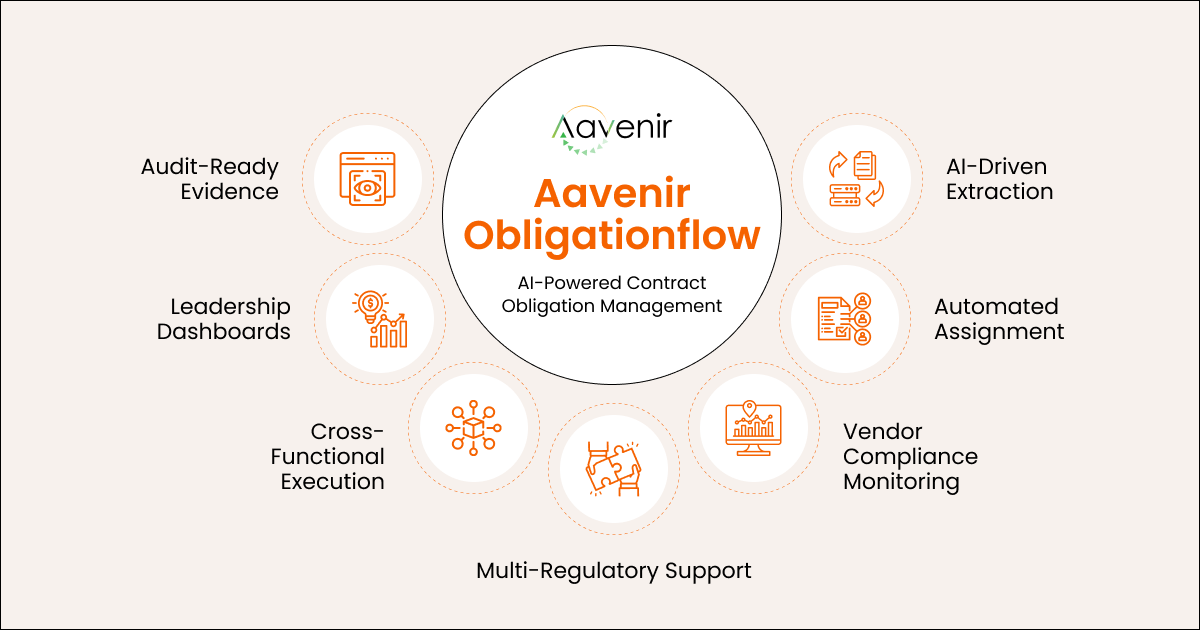
Before diving into specific capabilities, it is essential to understand the core value Aavenir brings. Aavenir’s AI-powered obligation management solution transforms obligations scattered throughout contracts into structured, actionable, and auditable workflows. This eliminates manual tracking, improves compliance, reduces risk, and ensures teams across clinical, financial, operational, and compliance functions work from a unified obligation system.
AI-Driven Extraction and Structuring
Aavenir automatically extracts obligations from payer agreements, provider contracts, compliance documents, quality standards, and vendor MSAs. Each obligation is categorized, normalized, and ready for operational execution.
Automated Assignment and Cross-Functional Execution
The system routes obligations to clinical teams, finance, operations, IT, or compliance leaders, ensuring clear ownership and timely execution.
Vendor Compliance and SLA Monitoring
Healthcare supply chain and vendor management teams gain visibility into SLA adherence, device servicing obligations, cybersecurity commitments, and timely delivery requirements.
Audit-Ready Documentation and Traceability
All evidence, approvals, communications, certifications, and clinical logs are stored directly against each obligation for easy retrieval during audits or inspections.
Centralized Dashboards for Leadership
Executives gain real-time insights into compliance status, overdue obligations, high-risk areas, vendor performance, and regional differences.
Multi-Regulation Support for Global Healthcare Organizations
Aavenir supports HIPAA, GDPR, CMS, Joint Commission, ISO standards, NHS guidelines, and medical device compliance. This makes it ideal for healthcare organizations working across regions.
Want to Explore the Full Capability Framework?
Download the Aavenir Obligationflow Datasheet to see detailed workflows, automation capabilities, healthcare use cases, and compliance features designed to streamline healthcare obligation management.
Conclusion
Obligation management is central to healthcare quality, safety, reimbursement, vendor oversight, and regulatory compliance. Yet many organizations still rely on manual tracking, which cannot keep pace with the growing complexity.
AI-powered obligation management provides the structure, automation, visibility, and evidence healthcare organizations need to stay compliant, reduce risk, and protect revenue. With Aavenir, healthcare providers and payers move from reactive issue management to proactive governance, enabling safer care delivery and stronger regulatory confidence.
Ready to Strengthen Compliance and Obligation Management in Healthcare?
If you want to explore how Aavenir’s Compliance and Obligation Management solutions can help your organization stay audit-ready, reduce risk, and streamline operations across payer, provider, and regulatory workflows, book a personalized demo with our team today.
See how Aavenir can transform your compliance and obligation processes end-to-end.