
Contracts are at the core of every business relationship; customers, suppliers, employees, and partners. Yet for many organizations, contract processes remain slow, manual, and fragmented. Drafting contracts from static templates, routing approvals over email, tracking versions, and following up on signatures often leads to delays, errors, and unnecessary risk.
This is where contract automation has emerged as a game-changer. Contract automation enables organizations to streamline contract creation, review, approval, signing, and management, reducing manual effort while improving speed, accuracy, and control. As businesses scale, teams become more distributed, and regulatory scrutiny increases, automation is no longer optional; it is foundational to modern contract operations.
This shift toward automation is also reflected in market adoption trends. The global Contract Lifecycle Management (CLM) software market – which underpins contract automation – was valued at approximately USD 17.4 billion in 2024 and is projected to reach USD 47.33 billion by 2032, underscoring the rapid pace of investment in digital, automated contract processes.
As organizations look to modernize their contract operations, understanding what contract automation truly entails – and how it reshapes the contract lifecycle – becomes essential.
What Is Contract Automation?
Contract automation refers to the use of software and digital workflows to automate repetitive, rules-based activities across the contract lifecycle, starting from contract creation through execution and post-signature management.
At its core, contract automation software enables teams to:
- Generate contracts from standardized templates
- Auto-populate data from systems like CRM or HR tools
- Route contracts for approval based on predefined rules
- Track negotiations, versions, and signatures
- Store executed contracts centrally for search and reporting
Contract Automation vs Traditional Contract Management
Traditional contract management relies heavily on manual processes, including:
- Static templates stored in folders
- Email-based approvals
- Version confusion
- Limited visibility once contracts are signed
Contract automation replaces these fragmented steps with structured workflows, standardized logic, and system-driven controls, ensuring contracts move faster with fewer errors.
Where Contract Automation Fits in the Contract Lifecycle
Contract automation spans multiple stages of the contract lifecycle:
- Pre-signature: drafting, approvals, and negotiation
- Signature: execution and audit trail
- Post-signature: storage, tracking, reporting, and compliance
Rather than treating contracts as static documents, automation enables organizations to manage contracts as living business assets.
Why Contract Automation Matters
Contracts influence revenue, risk, compliance, and operational efficiency across the enterprise. Yet in many organizations, contract processes remain disconnected from core business systems and heavily dependent on manual effort. As contract volumes increase, teams expand across geographies, and regulatory requirements grow more complex, these manual approaches struggle to scale. Contract automation matters because it brings structure, consistency, and visibility to a process that directly impacts business outcomes, enabling organizations to move faster while maintaining control and governance.
a. Business Efficiency
Manual contract processes often create hidden bottlenecks across organizations. Teams spend significant time copying data between systems, coordinating approvals through email, and following up on signatures, all of which slows down deal velocity and increases operational friction.
Contract automation addresses these challenges by eliminating repetitive administrative work and introducing consistent, system-driven workflows. By standardizing how contracts are created and approved across teams, organizations can significantly reduce contract cycle times and enable revenue to move faster.
b. Accuracy and Consistency
Relying on manual drafting increases the likelihood of incorrect clauses, missing terms, and inconsistent language across contracts. Over time, this lack of standardization can expose organizations to unnecessary legal and financial risk.
Automation ensures that only approved templates and clauses are used, with predefined logic governing how contractual language is applied. This reduces errors caused by copy-paste practices or outdated documents and helps maintain consistency across all agreements.
c. Improved Compliance
As regulatory requirements and internal policies continue to evolve, maintaining compliance through manual processes becomes increasingly difficult. Without structured controls, it is easy for non-compliant language or unauthorized changes to slip through.
Contract automation enforces the use of pre-approved legal language and policy rules throughout the contract lifecycle. It also creates clear audit trails for approvals and changes, making it easier for organizations to demonstrate compliance and respond to audits or regulatory reviews.
d. Better Collaboration and Visibility
Contracts typically involve multiple stakeholders, including legal, sales, procurement, finance, and HR. When collaboration happens across emails and disconnected tools, visibility is limited, and accountability becomes unclear.
Automation provides a centralized contract repository where teams can collaborate in real time, add comments, and track changes. With greater visibility into contract status, ownership, and bottlenecks, organizations can manage contracts more proactively and reduce delays caused by misalignment or handoffs.
Why Organizations Hesitate to Adopt Contract Automation
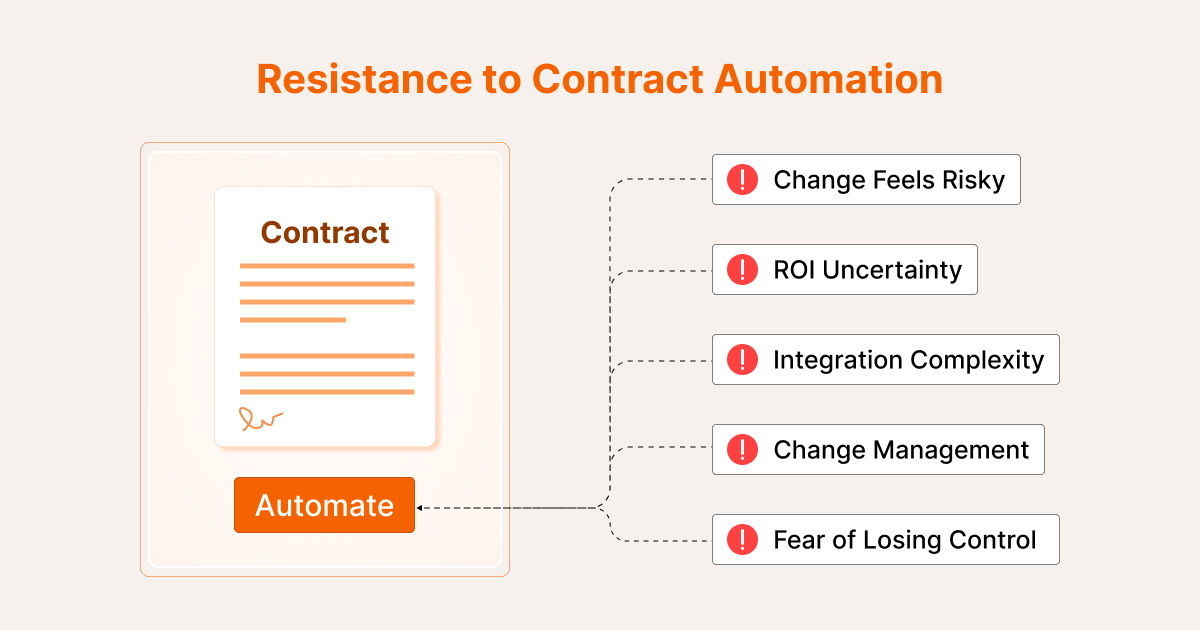
While contract automation is widely recognized as a powerful enabler of efficiency, consistency, and compliance, many organizations approach adoption cautiously. Contracts sit at the intersection of legal risk, commercial value, and regulatory accountability, making any change to how they are managed feel high stakes. As a result, hesitation around contract automation is rarely about technology alone. It is driven by concerns around control, trust, integration, and the perceived impact on established legal and business workflows.
Change Feels Risky in Legal and Contract Processes
Contracts are deeply tied to risk management and accountability. For legal and business teams, existing manual processes often feel safer because they are familiar and have been refined over time. Individual expertise, judgment, and informal checks are embedded into these workflows, making automation appear risky rather than reassuring.
Fear of Losing Control Over Contract Language and Approvals
Many organizations worry that automation could limit flexibility in contract negotiations or allow agreements to move forward without sufficient oversight. Standardized templates and automated routing are sometimes seen as reducing the ability to apply nuanced legal judgment, particularly in complex or regulated environments.
Complexity of Integrating with Existing Systems
Contract processes rarely exist in isolation. They depend on data from CRM, ERP, finance, and document management systems. Organizations hesitate to adopt contract automation when there is uncertainty about how it will integrate with existing technology, how data will be synchronized, and how security and ownership will be maintained.
Perceived Implementation and Change Management Effort
There is a common assumption that contract automation requires long implementation timelines, heavy configuration, and widespread retraining. For organizations with lean legal or operations teams, this perceived effort can create reluctance, even when the long-term benefits are clear.
Uncertainty About ROI and Business Impact
While automation promises efficiency and risk reduction, many organizations struggle to quantify its immediate business value. Without clear metrics or benchmarks, decision-makers may delay adoption in favor of initiatives with more predictable short-term outcomes.
Automation as an Enabler, Not a Replacement
In practice, modern contract automation platforms are designed to preserve oversight and flexibility while reducing manual effort. They support legal expertise through configurable workflows, approval controls, and standardized logic, allowing teams to focus on higher-value legal and commercial decisions rather than administrative tasks.
Core Features of Contract Automation Software
Modern contract automation software is designed to remove friction from contract workflows while preserving governance and flexibility. Rather than focusing on isolated features, these platforms combine templates, workflows, collaboration, AI, and analytics into a unified system that supports the entire contract lifecycle. Understanding these core capabilities helps organizations evaluate how well a solution can support both legal oversight and business agility.
Automated Templates and Conditional Logic
Pre-approved templates form the foundation of contract automation. Conditional logic allows contracts to dynamically adapt based on factors such as deal type, geography, contract value, or counterparty, ensuring that the right language is applied without manual intervention. This approach reduces drafting time while maintaining consistency and compliance across agreements.
Workflow Automation
Workflow automation ensures contracts are routed to the appropriate stakeholders for review and approval based on predefined rules. Notifications, reminders, and escalation mechanisms keep contracts moving forward, reducing delays caused by manual coordination and improving accountability across teams.
E-Signatures and Execution Tracking
Integrated e-signature capabilities enable contracts to be executed quickly and securely. Execution tracking provides visibility into signing status and creates a complete audit trail, ensuring transparency and compliance throughout the execution process.
Collaboration Tools
Built-in collaboration tools allow teams to comment, suggest edits, and track versions within a single system. This reduces reliance on email chains and disconnected documents, improving clarity and ensuring all stakeholders are working from the most current version of the contract.
AI-Powered Capabilities
Artificial intelligence enhances contract automation by supporting tasks such as clause suggestions, risk identification, and automated contract review. These capabilities help legal and business teams identify deviations from standards more efficiently while focusing human expertise on complex decision-making.
Dashboards and Reporting
Dashboards provide real-time insights into contract performance, including cycle times, negotiation patterns, bottlenecks, and overall contract volume. These insights enable organizations to continuously improve contract processes and make data-driven decisions.
Integration with Existing Systems
Contract automation delivers the most value when integrated with existing enterprise systems such as CRM, ERP, and HR platforms. Seamless integration ensures accurate data flow, reduces duplicate data entry, and connects contracts directly to upstream and downstream business processes.
Disconnected systems hold you back, learn more about Aavenir’s integration capabilities.
Benefits of Contract Automation Across the Organization
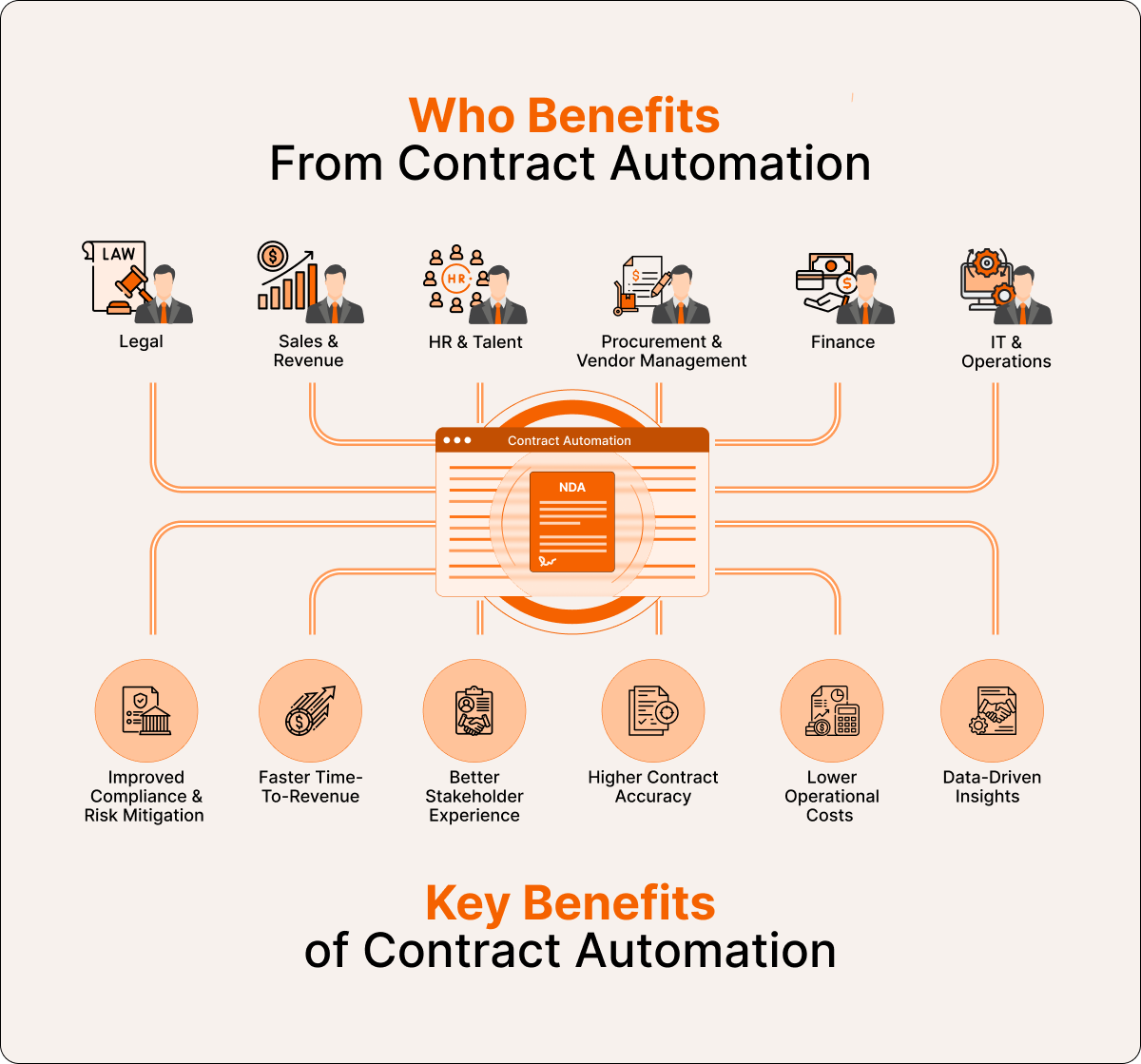
Contract automation delivers value far beyond operational efficiency. By streamlining how contracts are created, approved, executed, and managed, it impacts multiple functions across the organization, improving speed, accuracy, compliance, and overall business outcomes. The benefits of automation are most visible when viewed through the lens of the teams that rely on contracts every day.
1. Legal Teams Gain Control Without Added Overhead
For legal teams, contract automation reduces the burden of repetitive drafting, formatting, and administrative coordination. Standardized templates and automated approvals help ensure consistency and compliance, while audit trails and version control improve governance. This allows legal professionals to shift focus from routine contract work to higher-value activities such as risk assessment, negotiation strategy, and advisory support.
2. Sales and Revenue Teams Close Deals Faster
Sales teams benefit from faster contract generation and approval cycles. By removing manual handoffs and delays, contract automation shortens time to revenue and reduces friction during negotiations. Sales users can initiate contracts directly from CRM systems, apply approved terms automatically, and track execution progress in real time, resulting in smoother customer experiences and quicker deal closure.
3. HR and Talent Teams Improve Speed and Consistency
HR teams use contract automation to streamline employee-facing agreements such as offer letters, employment contracts, and policy acknowledgments. Automation ensures consistency in language, faster turnaround times, and better tracking of signed documents, which improves both candidate experience and internal compliance.
4. Procurement and Vendor Management Reduce Risk and Cost
In procurement, contract automation standardizes supplier agreements and enforces approval controls across vendor contracts. Automated workflows reduce cycle times, while centralized storage improves visibility into supplier terms, obligations, and renewals. This leads to better cost control, reduced risk exposure, and more effective vendor governance.
5. Finance Teams Gain Visibility Into Financial Exposure
Finance teams benefit from improved insight into contractual obligations, payment terms, renewals, and financial commitments. With contract data structured and accessible, finance leaders can better forecast exposure, manage renewals, and support compliance and audit requirements.
6. IT and Operations Enable Secure, Scalable Processes
From an IT and operations perspective, contract automation reduces system sprawl by centralizing contract workflows within governed platforms. Integrations with CRM, ERP, and HR systems ensure data consistency, while role-based access and security controls help maintain compliance and scalability as contract volumes grow.
The impact of contract automation becomes most tangible when viewed across the teams that rely on contracts every day, as shown below.
How Contract Automation Delivers Value Across the Organization
| Function | Key Challenges Without Automation | How Contract Automation Helps | Business Impact |
| Legal | Manual drafting, version confusion, high review workload | Standardized templates, automated approvals, audit trails | Better governance, reduced risk, more time for strategic legal work |
| Sales & Revenue | Slow contract turnaround, approval delays, deal friction | Faster contract generation, real-time execution tracking | Shorter sales cycles and faster time to revenue |
| HR & Talent | Inconsistent offer letters, manual onboarding paperwork | Automated employee agreements and document tracking | Improved candidate experience and compliance |
| Procurement & Vendor Management | Lengthy supplier approvals, limited visibility into terms | Standardized vendor contracts and approval workflows | Reduced risk, better cost control, improved vendor governance |
| Finance | Limited insight into obligations, renewals, and exposure | Centralized contract data and reporting | Improved forecasting, audit readiness, and financial control |
| IT & Operations | Disconnected tools, security concerns, scalability issues | Integrated workflows with role-based access controls | Secure, scalable contract operations |
How Contract Automation Works: Step-by-Step Workflow
Contract automation is most effective when it is implemented as a structured flow, not a collection of disconnected tools. The goal is to standardize contract creation, reduce manual coordination, and maintain strong governance from drafting through post-signature management. Below is a practical step-by-step guide to how contract automation typically works in modern organizations.
Step 1: Template Creation Using Legal-Approved Language
The foundation of contract automation is a library of templates and clause playbooks that legal teams have reviewed and approved. Instead of relying on static Word files stored in folders, templates are maintained in a controlled environment where versioning and ownership are clear.
At this stage, legal teams typically:
- Identify high-volume contract types such as NDAs, MSAs, SOWs, vendor agreements, and employment agreements
- Convert existing templates into standardized formats with clearly defined sections and clause options
- Define which clauses are mandatory, optional, or conditional based on business context
- Establish fallback language and negotiation positions for common redlines
- Assign ownership and governance rules so templates stay updated as policies and regulations change
A well-structured template library prevents contract teams from starting from scratch and ensures that approved legal language is consistently used across the organization.
Step 2: Data Collection and Population From Connected Systems
Once templates exist, automation works by pulling structured data from upstream systems and using it to populate contract fields. This eliminates repetitive copy-paste work and reduces errors caused by inconsistent or outdated data.
Common data sources include:
- CRM systems for customer details, pricing, products, and deal terms
- ERP or procurement platforms for supplier information, payment terms, and purchase order references
- HR systems for employee details, compensation, and start dates
- Identity and master data systems for standardized entity names and addresses
Many automation flows also include guided intake forms. A salesperson, recruiter, or procurement user answers a short set of questions, and the system uses those inputs to populate the right fields and select the right contract variation.
This step is where contract automation begins to feel fast for business teams because contract creation becomes a controlled process driven by data rather than manual document assembly.
Step 3: Workflow Configuration for Approvals and Reviews
After the contract is generated, the next challenge is routing it through the right review and approval steps. Workflow configuration ensures every contract follows a predictable, policy-aligned path based on predefined rules.
Approval logic is usually built around:
- Contract type and template used
- Contract value thresholds
- Risk indicators such as non-standard terms, indemnity changes, or data privacy language
- Geography and governing law requirements
- Counterparty category, such as strategic customer, high-risk vendor, or new supplier
- Business unit ownership and budget responsibility
The platform can route contracts to legal, finance, security, procurement, or leadership automatically. It also includes reminders, escalation rules, and due-date tracking so contracts do not stall in inboxes.
This step is critical because most contract delays happen not during drafting but during coordination. Workflow automation removes that friction while keeping oversight intact.
Step 4: Automated Approval and Execution With Audit Trails
Once reviews are completed, contract automation supports controlled execution. This includes final approvals, signature workflows, and complete traceability of what changed and who approved it.
Execution typically includes:
- Final contract validation, ensuring required fields and clauses are present
- Automatic creation of signature packets based on signatory roles and authority levels
- Integrated e-signature workflows with signing order, reminders, and identity verification when required
- A full audit trail capturing revisions, approvals, timestamps, and signer actions
Auditability is not just a compliance feature. It is also operational insurance. When disputes arise or audits occur, teams can quickly show who approved what, when it was approved, and which version was signed.
Step 5: Storage and Tracking in a Centralized Repository
After signing, the contract should not disappear into email or shared drives. Centralized storage ensures executed contracts are searchable, reportable, and usable for downstream workflows.
A strong repository setup typically includes:
- Secure storage with role-based access control
- Metadata capture, such as parties, effective dates, term dates, renewal terms, payment terms, and governing law
- Search and retrieval by keyword, fields, or contract type
- Alerts for renewals, expirations, obligations, and key milestones
- Reporting dashboards for cycle times, bottlenecks, contract volume, and risk trends
This final step is where organizations begin unlocking long-term value. Contracts become structured business assets that can be monitored, analyzed, and used to improve compliance, performance, and decision-making over time.
Choosing the Right Contract Automation Solution
Selecting a contract automation solution is a long-term decision that affects multiple teams and business processes. The right platform should balance ease of adoption, governance, and scalability while fitting seamlessly into the existing technology landscape.
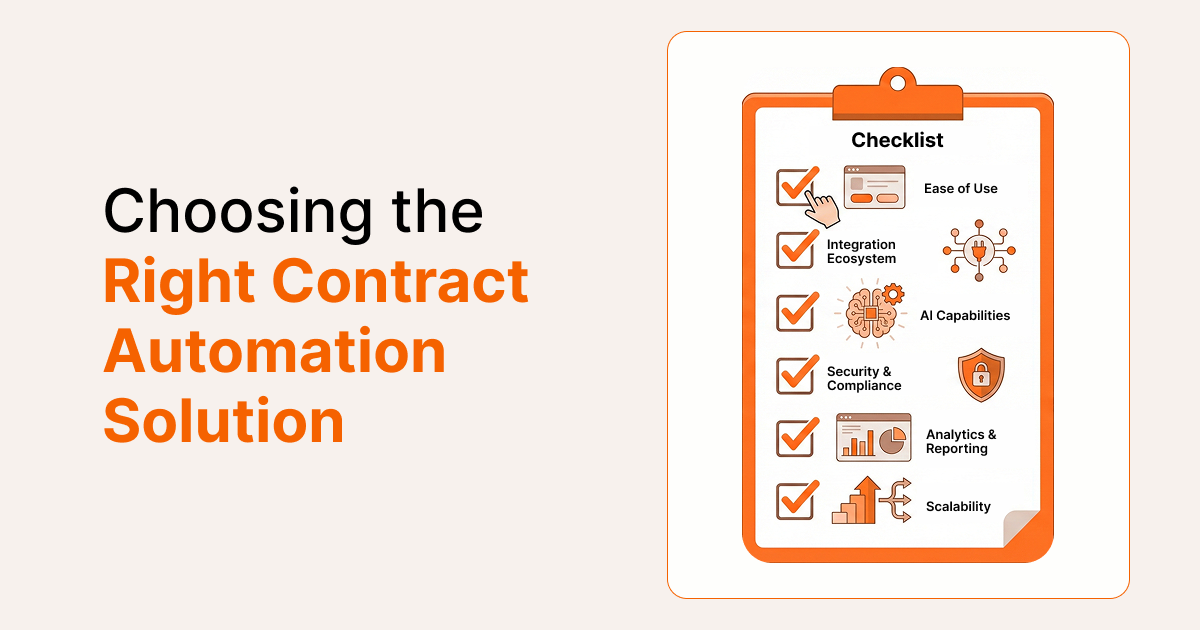
Ease of Use
The platform should be intuitive for business users while preserving legal control. Simple contract creation and approval experiences are critical for adoption and consistency.
Integration Ecosystem
Strong integrations with CRM, ERP, HR, and e-signature systems ensure accurate data flow and reduce manual effort across the contract lifecycle.
AI Capabilities
AI should support practical use cases such as clause suggestions, risk identification, and contract review, helping teams work faster without sacrificing oversight.
Security and Compliance
Enterprise-grade security, role-based access, audit logs, and regulatory compliance are essential to protect sensitive contract data and ensure governance.
Analytics and Reporting
Built-in contract analytics should provide visibility into contract cycle times, bottlenecks, and performance, enabling continuous process improvement.
Scalability
The solution must scale with growing contract volume, complexity, and geographic expansion without compromising performance or control.
Contract Automation: The Future Is Here
Contract automation is evolving beyond efficiency into a strategic capability. As contracts become structured, connected, and intelligent, they are shifting from static documents to active business assets. AI is enabling smarter drafting, faster reviews, and earlier risk detection, while predictive insights help organizations anticipate delays and negotiation friction before they occur. At the same time, deeper integration with CRM, procurement, finance, and HR systems is embedding contracts directly into everyday business workflows.
For executive and AI-focused leaders, the future of contract automation lies in using contract data to drive better decisions, stronger governance, and scalable growth.
The Closing Note
Contract automation has become essential for organizations navigating growing contract volumes, distributed teams, and increasing regulatory scrutiny. Manual, document-driven processes are no longer sufficient to support the speed, accuracy, and visibility required in modern contract operations.
By automating contract creation, approvals, execution, and tracking, organizations can reduce friction, improve consistency, and maintain strong legal and compliance control. The most successful approaches treat automation as an enabler of expertise rather than a replacement for it, allowing legal and business teams to focus on higher-value work.
As contract automation continues to mature, organizations that invest early will be better positioned to manage risk, accelerate outcomes, and turn contracts into a source of long-term operational and strategic advantage.
Prepare Your Contract Operations for What’s Next
As contract complexity and regulatory expectations continue to rise, modernizing contract operations is no longer optional. Aavenir helps organizations move beyond manual processes and adopt intelligent, scalable contract automation that balances speed with strong legal and compliance control.
Explore how Aavenir Contractflow can future-proof your contract lifecycle. Book a Demo
Frequently Asked Questions (FAQs)
What’s the difference between contract automation and CLM?
Contract automation focuses on automating contract creation and execution, while CLM covers the entire contract lifecycle end-to-end.
Can small businesses benefit from contract automation?
Yes. Automation reduces manual effort and ensures consistency even with limited legal resources.
How secure is contract automation software?
Leading platforms offer enterprise-grade security, role-based access, and audit trails.
Does automation replace lawyers?
No. Automation supports lawyers by removing repetitive work, allowing them to focus on complex legal decisions.