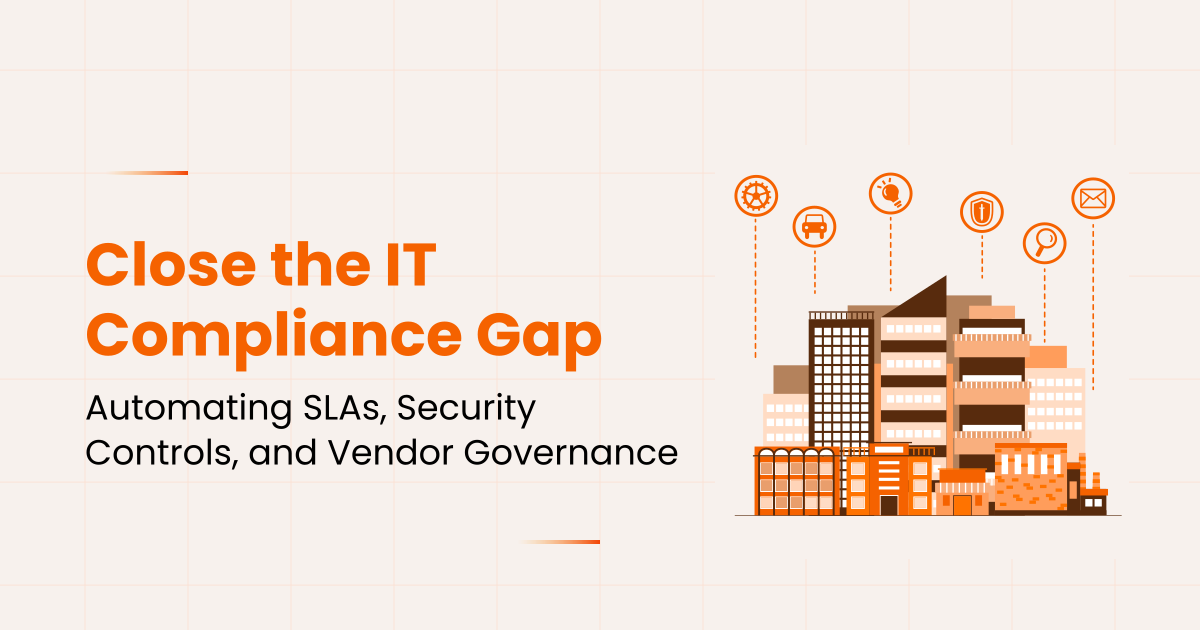
IT contracts are full of uptime guarantees, security certifications, disaster recovery targets, and regulatory commitments. Most organizations track them manually, leading to missed service credits, audit stress, compliance gaps, and financial leakage.
By combining AI-powered obligation extraction with native ServiceNow workflows, organizations can automate SLA tracking, trigger remediation tasks, and achieve real auto-fulfillment without manual chasing.
Why IT Governance Is Still Stuck in the Document Era
IT environments move at machine speed. Contracts do not.
Every SaaS agreement, managed service contract, cloud hosting arrangement, and cybersecurity vendor agreement contains operational commitments such as uptime percentages, response times, security audits, encryption standards, and regulatory safeguards.
Yet most organizations still manage these obligations using spreadsheets, email reminders, or static contract repositories.
This creates four systemic risks:
- IT SLA obligations do not move into automated workflows
- Certifications and security commitments are not continuously verified
- Fulfillment depends on manual follow-ups
- Service credits are missed and penalties are incurred
IT governance must evolve from passive contract storage to active, automated execution.
The AI-Driven Extraction of IT Obligations
IT contracts are not simple commercial agreements. They are operational blueprints that define uptime commitments, security certifications, incident response timelines, encryption standards, disaster recovery targets, and regulatory safeguards.
Yet in most organizations, these obligations remain embedded in dense contractual language. Traditional contract systems extract basic metadata such as parties and effective dates, but the operational clauses that drive risk and performance remain unstructured and unmanaged.
This is where governance breaks down.
When uptime thresholds, SOC2 audit commitments, RTO targets, and breach notification requirements are not converted into structured workflows, they rely on manual interpretation and follow-up. The result is fragmented accountability, delayed response, and increased regulatory exposure.
Aavenir addresses this gap by using AI to extract operational IT obligations directly from contracts. Instead of stopping at administrative data, the system identifies:
- Service Level Agreements, such as uptime guarantees and critical response commitments
- Security protocols, including annual certifications and encryption requirements
- Disaster recovery targets, including defined RTO and RPO thresholds
These clauses are transformed into structured obligation records inside ServiceNow, where they can be assigned, monitored, and fulfilled systematically.
AI performs the technical interpretation at scale.
Your legal and IT teams focus on governance, vendor performance, and risk mitigation rather than manual clause review.
Contracts move from static documents to active compliance controls.
Screening for the Big Three with Aavenir ComplianceNext
IT governance today goes far beyond uptime and response times. Regulators now define how vendors handle data, manage AI systems, secure infrastructure, and maintain operational resilience.
That means every IT contract is also a regulatory exposure document.
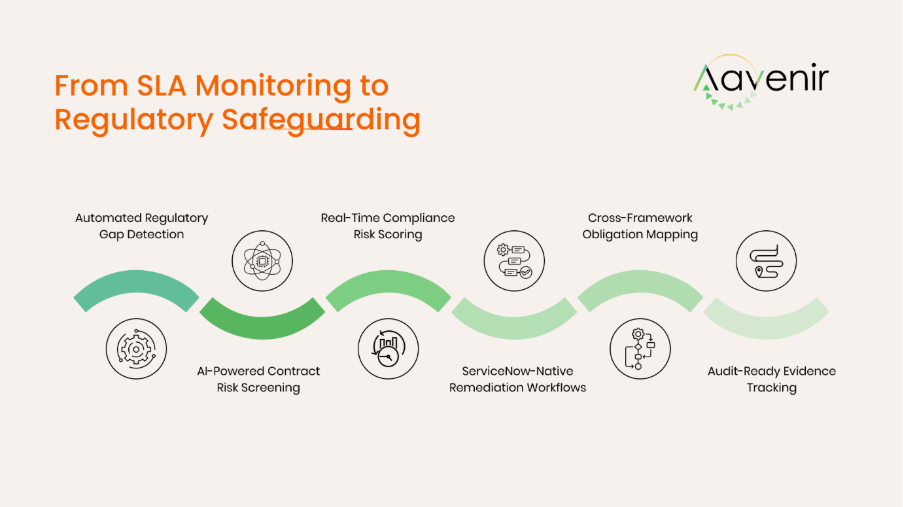
Moving From SLA Monitoring to Regulatory Safeguarding
Many organizations signed vendor contracts years ago. Since then, GDPR enforcement has intensified, CCPA requirements have evolved, the EU AI Act has introduced new classifications, and DORA has reshaped ICT third-party risk standards.
The contract language, however, often remains unchanged.
This creates silent regulatory gaps.
Modern organizations must embed security governance in ServiceNow to continuously align vendor performance with evolving regulatory standards.
How Aavenir ComplianceNext Screens IT Contracts
Aavenir ComplianceNext uses structured compliance checklists to evaluate IT contracts against modern regulatory guardrails.
Data Protection and Security Compliance
The system automatically identifies missing or weak references to GDPR, CCPA, NIST frameworks, or required data protection obligations. If encryption standards or breach notification timelines are unclear, they are flagged immediately.
EU AI Act Risk Exposure
If a vendor provides AI-driven services that may fall under high-risk classification, ComplianceNext identifies the exposure early. This gives organizations time to review vendor accountability before enforcement deadlines approach.
DORA and ICT Third-Party Risk Alignment
For organizations operating in Europe, ComplianceNext validates whether ICT vendor contracts meet Digital Operational Resilience Act standards. Missing resilience clauses, audit rights, or risk reporting commitments are surfaced proactively.
Automated Gap Remediation
If the system detects a missing mandatory security or regulatory clause, it does not just generate a report.
It triggers a structured Gap Remediation task inside ServiceNow. Legal and IT teams receive clear ownership assignments, along with context on what needs to be addressed.
Instead of discovering compliance gaps during audits, organizations resolve them before regulators ever ask.
Compliance becomes proactive.
Risk becomes measurable.
Vendor governance becomes enforceable.
Facing increasing audit pressure or regulatory scrutiny?
Aavenir ComplianceNext centralizes evidence workflows, automates control validation, and keeps your IT governance audit-ready at all times. See how it works!
Smart Assignment: Putting the Right Work in the Right Hands
Extraction and screening are only the beginning. Governance succeeds when obligations are incorporated into operational workflows.
IT obligations often fail because they are stored in legal repositories rather than in operational systems.
Aavenir ensures each obligation is assigned to the team responsible for execution:
- Uptime SLAs route to the SRE team
- Security certifications route to the CISO organization
- Billing milestones route to IT Finance
Assignments occur directly within ServiceNow Assignment Groups. Tasks land where teams already work. No parallel tracking systems. No manual coordination loops.
Governance becomes an operational reality.
The Closed Loop: Auto-fulfillment via ITSM
Tracking is insufficient. Execution is essential.
Aavenir links obligation records directly to ServiceNow ITSM.
Consider a quarterly vulnerability scan requirement embedded in a vendor agreement:
- Aavenir Obligationflow generates an ITSM incident aligned to the deadline
- The IT team completes the scan and uploads documentation within the ticket
- Aavenir AI evaluates the evidence
- The obligation is marked fulfilled automatically
This demonstrates how to automate SLA compliance in IT workflows by embedding contractual obligations directly into operational execution systems.
No manual updates.
No spreadsheet reconciliations.
No email follow-ups.
This creates a closed-loop compliance engine that integrates contractual commitments directly into operational systems.
Realizing Direct ROI: The Financial Case
Governance is not only about risk mitigation. It directly impacts financial outcomes.
Organizations typically lose between 5 and 15 percent of IT contract value due to SLA leakage and missed service credits.
Capturing Missed Service Credits
When ITSM logs outages or performance degradation, the system cross-references SLA thresholds and automatically flags service credit eligibility.
This makes Aavenir one of the most effective tools for automating SLA breach alerts in IT, enabling proactive remediation before penalties escalate.
You stop paying full price for underperformance.
Strengthening Audit Defense
Timestamped, ITSM-linked audit trails provide structured evidence for GDPR, EU AI Act, DORA, and other regulatory reviews.
Financial recovery improves.
Penalty exposure decreases.
Governance becomes quantifiable.
Monitoring the Pulse: Dashboards and SLA Intelligence
Visibility drives accountability.
Executive Risk Heatmap
Leadership receives a real-time risk overview of IT vendors based on SLA performance, security compliance status, and breach history.
Operational Dashboard
Teams gain access to:
- Real-time SLA tracking tables
- Certification validity and expiration reports
- Upcoming obligation timelines with risk prioritization
CIOs, CISOs, and Vendor Management leaders operate from a single source of truth.
The AI Intelligence Layer: From Reactive to Predictive Governance
Most organizations automate reminders. Very few operationalize intelligence.
Traditional SLA tracking systems answer one question:
“Is the deadline approaching?”
AI answers a more important one:
“Is this vendor likely to fail before the deadline even arrives?”
That difference defines modern governance.
Moving Beyond Deadline Tracking
Automation ensures tasks are assigned and reminders are sent. That is necessary but insufficient. AI analyzes behavioral patterns. Instead of reacting to breach notifications, AI identifies early warning signals.
Vendor Reliability Scoring
Dynamic vendor risk scoring based on performance reality. Vendor governance shifts from document-based to performance-based.
Continuous Regulatory Re-Evaluation
Regulatory frameworks do not stand still.
When GDPR enforcement guidance evolves, when DORA clarifications are issued, or when the EU AI Act introduces new classifications, AI removes delay and ensures governance keeps pace with regulation.
AI removes that delay and ensures governance keeps pace with regulation.
Breach Probability Modeling
AI does not only flag non-compliance. It estimates the likelihood. The system can surface obligations that are at high risk of breach in the next cycle. This allows intervention before failure. It transforms governance from reactive monitoring to proactive risk management.
Governance Shifts from Monitoring to Anticipation
Manual governance asks: “Was the obligation met?”
Predictive governance asks: “Will this obligation fail if nothing changes?”
That shift changes everything. AI becomes the intelligence engine behind autonomous compliance. This strengthens ServiceNow IT asset SLA management by aligning contractual performance with operational asset visibility.
Conclusion: The Future of IT Governance Is Autonomous
IT governance moves too fast for manual tracking.
By connecting contracts directly to ServiceNow workflows, organizations move beyond managing obligations. They fulfill them autonomously.
Contracts become living workflows.
Compliance becomes continuous.
SLA governance becomes self-executing.
Ready to Move From SLA Tracking to Autonomous IT Governance?
What if every SLA, certification, and regulatory obligation were executed automatically without manual intervention? What if service credits were captured instantly and compliance gaps were resolved before audits?
Book a personalized demo to see how your IT contracts can start working for you.
Frequently Asked Questions
1. How does AI accurately extract complex IT SLA clauses?
Aavenir AI is trained to recognize technical IT terminology, including uptime percentages, MTTR definitions, encryption requirements, certification timelines, and disaster recovery metrics. It converts them into structured obligation records inside ServiceNow for operational tracking.
2. Can this solution integrate natively with ServiceNow ITSM?
Yes. Obligationflow operates within ServiceNow and integrates directly with ITSM incidents, tasks, and assignment groups to create closed-loop fulfillment workflows.
3. How does the system help recover missed service credits?
When ITSM logs outages or SLA breaches, the platform cross-references contractual thresholds and automatically flags eligible service credits, preventing financial leakage.
4. Does Aavenir ComplianceNext help with evolving regulations like DORA and the EU AI Act?
Yes. ComplianceNext uses structured regulatory playbooks to screen IT contracts for missing or weak clauses aligned to GDPR, CCPA, EU AI Act, DORA, and other frameworks.
5. What is the primary business benefit of automating IT SLA governance?
The primary benefit is risk reduction combined with financial optimization. Organizations reduce manual workload, prevent compliance gaps, capture service credits, and maintain continuous audit readiness.