
Every executed contract in a financial institution is two documents. The first is the one legal negotiated, reviewed, redlined and signed. The second is the one operations inherits: a dense set of commitments the institution must now keep, on schedules nobody entered into a system. Published industry research suggests around 40% of contracts fail to deliver their intended value, and roughly 70% of contract cost and risk lands after signature, in exactly the window where most institutions stop looking.
In banking and insurance, the consequences are not abstract. A missed regulatory reporting commitment is an examiner finding. An untracked SLA credit is money left with the vendor. An unexercised right-to-audit clause is a third-party risk exception. And the traditional fix, obligation spreadsheets maintained by whoever negotiated the deal, degrades with every reorganization, renewal and departure.
This datasheet describes how Aavenir obligation management closes that gap: which obligation types it tracks, how the AI extraction works, the capabilities your teams get on day one, and where it fits alongside your GRC and third-party risk stack.
Which obligations does it track?
Aavenir handles the term-heavy, high-risk commitments unique to banks, insurers, asset managers and fintechs. The categories below are not exhaustive, extraction reads whatever the contract actually says, but they cover the obligations that carry examiner, financial or litigation consequences when missed:
Regulatory and compliance commitments
Reporting duties and control-evidence commitments under regimes such as SOX and Dodd-Frank, the obligations where a missed date becomes a finding. Extraction surfaces the duty, the frequency and the responsible party; workflow drives each cycle to documented closure.
Vendor and third-party obligations
SLA and service-credit terms, right-to-audit and examination-access clauses, data-protection and breach-notification duties, subcontracting restrictions and exit-assistance commitments in vendor and outsourcing agreements, the backbone of third-party risk programs aligned to OCC and FFIEC guidance. See our third-party risk contract automation guide for the full lifecycle picture.
Counterparty and financing terms
ISDA and master agreement terms, covenants in loan and credit agreements, and deliverables in MSAs and SOWs, tracked with the same rigor as regulatory duties, because a missed covenant is a dispute waiting to happen.
Privacy and data obligations
GDPR and CCPA commitments embedded in contracts, data-handling restrictions, deletion duties, notification windows, extracted and assigned so privacy compliance does not depend on someone remembering clause 14.3.
A repository tells you where the contract is. Obligation management tells you what the contract demands, who owes what, to whom, by when, and proves each commitment was met. That distinction is the difference between records and controls.
How does AI obligation extraction work?
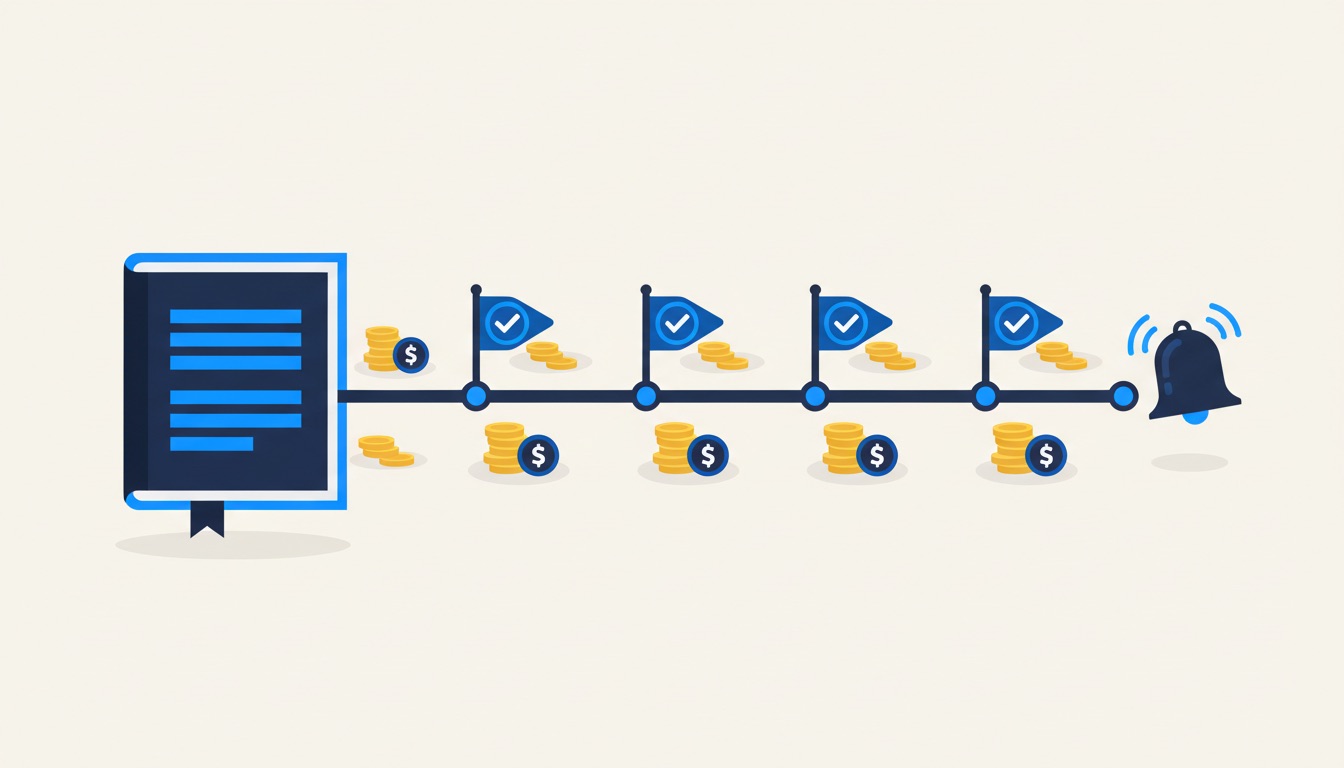
The workflow runs in four stages, from executed document to closed commitment:
- 1, Ingest. Executed agreements land in one AI-searchable repository with full metadata and version history, whether they were authored in Aavenir or migrated from legacy stores.
- 2, Extract. NLP-driven extraction reads each contract and surfaces obligations, SLAs, deliverables, key dates and risky clauses across the portfolio, no manual abstraction pass.
- 3, Assign. Each obligation becomes a structured record with an owner, a due date and a fulfilment definition. Automated reminders drive reporting, audit and SLA deadlines toward closure.
- 4, Prove. Every assignment, reminder, escalation and closure is logged in an immutable audit trail with role-based controls, defensible evidence for examiners, auditors and disputes.
Because obligations, contracts, sourcing and third-party risk data share one connected platform, nothing is stranded in a side system: the vendor-risk reviewer sees the same obligation record as the contract owner. Extraction also works retroactively, point it at the legacy estate and it surfaces the commitments buried in agreements signed years before the system existed, which is where most institutions find their ugliest surprises.
Judgment stays human where it belongs. Extraction proposes the obligation, the clause reference and the suggested owner; your team confirms, adjusts or dismisses. The goal is not to remove review, it is to guarantee that no commitment reaches the portfolio without passing through one.
See extraction on a real agreement
Bring an executed vendor or master agreement and watch Aavenir surface the obligations, SLAs and audit rights inside it, live.
Capabilities at a glance
| Capability | What it does | Who relies on it |
|---|---|---|
| AI obligation extraction | NLP surfaces obligations, SLAs, deliverables, key dates and risky clauses from executed contracts | Legal ops, vendor risk |
| Assignment & tracking | Every obligation gets an owner, due date and automated reminders, tracked to closure | Compliance, operations |
| Immutable audit trail | Logs every edit, approval, assignment and closure, SOX-aligned, examiner-ready evidence | Internal audit, compliance |
| SLA management | Tracks and enforces service levels and credits across vendor and outsourcing agreements | Vendor management, procurement |
| Central repository | One AI-searchable source of truth with metadata, version history and instant retrieval | Legal, audit, procurement |
| Connected platform | Contracts, obligations, sourcing and third-party risk share one data model, standalone or native on ServiceNow | IT, GRC, procurement |
What you get
- ✓100% of extracted obligations owned and tracked, reporting commitments, audit rights and service levels assigned to named owners with deadlines, not rows in a spreadsheet.
- ✓Examiner-ready evidence on demand, immutable audit trails and version history mean audit preparation drops from weeks of reconstruction to hours of reporting.
- ✓Regulatory language enforced upstream, pre-approved, compliance-aware clause libraries put required SOX, Dodd-Frank and privacy language into every contract before it is signed.
- ✓SLA credits captured, not forgiven, service-level breaches surface automatically, so credits and remedies are claimed while they are still claimable.
- ✓One record for contract and commitment, no swivel-chair between CLM, GRC and procurement; obligations live with the agreements that created them.
- ✓Fast, low-risk deployment, go live in weeks with a proven implementation model, not a multi-year program.
Who uses it, and for what?
Obligation management earns its keep across three teams that today reconcile the same commitments in three different spreadsheets:
- Compliance uses the obligation register as the evidence layer for regulatory commitments: every SOX- and Dodd-Frank-relevant duty has an owner, a cadence and a logged closure history that stands up in an exam.
- Vendor risk runs third-party oversight from the extracted record: right-to-audit clauses are scheduled and exercised, SOC-report deliveries are chased automatically, and breach-notification windows are visible before an incident tests them.
- Legal operations stops fielding “what does the contract say?” requests by hand. The AI-searchable repository and extracted obligations answer most questions directly, and renewal decisions start from what the vendor actually delivered, not from memory.
The common thread: each team works from the same record, so the vendor-risk review, the compliance attestation and the renewal negotiation stop diverging.
Where it fits in your compliance stack
Obligation management is not a replacement for your GRC platform or your third-party risk program, it is the contract-truth layer underneath both. GRC frameworks define what the institution must control; the contracts define what each counterparty actually owes. Aavenir keeps those two views reconciled automatically, and because it is deployed standalone or natively on ServiceNow, obligations flow into the workflows your teams already use. When the exam arrives, the question “how do you know every vendor commitment is being met?” has a system answer, the evidence bar we detail in what your CLM must prove in an exam.
The build-versus-buy question answers itself faster here than almost anywhere else in the compliance stack. Institutions have tried to solve obligation tracking with SharePoint lists, GRC custom objects and heroic spreadsheet owners; each works until the person maintaining it changes roles. Extraction quality, reminder discipline and trail integrity are product problems, not configuration problems.
Customers running contract and obligation management together report up to 5× faster contract cycles and, more importantly for regulated teams, a single audit-ready source of truth for every agreement and every commitment inside it. That is the difference between hoping the institution keeps its promises and being able to prove it.